
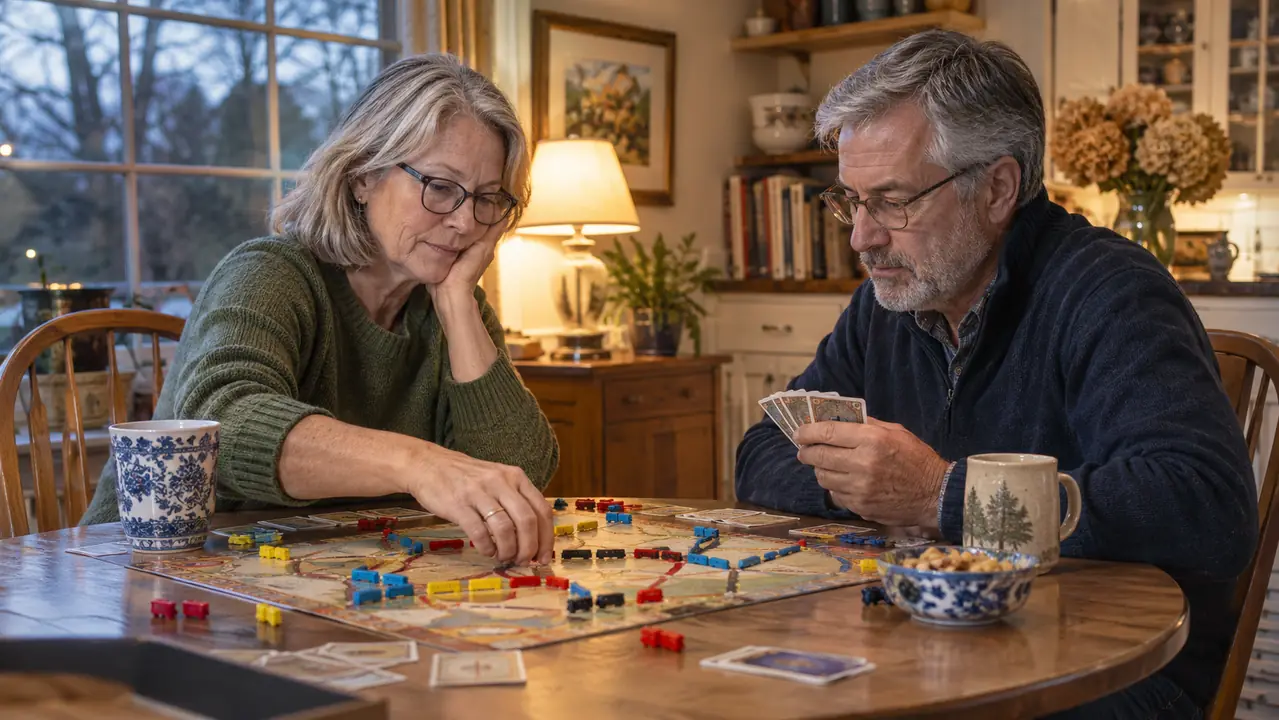
I bought Sky Team in May, on a Friday, at a game shop in Tyler that I had walked past for years without going in. Six months later it sits on top of the wicker basket on the sideboard, which is not where the games we stopped playing end up. That spot on top is reserved for whatever we are in the middle of.
Here is why that matters. My husband Hal is competitive. Not in an ugly way, but he is a man who keeps score in his head long after the board is back in the box. Sky Team is made by Scorpion Masqué and it is the only game in our house where the two of us are on the same side. That has turned out to be worth more than I expected. And we do not play it because we ought to. We play it because Friday comes around and one of us says, are we flying tonight?
The Quick Verdict
Six months in, this is still the game we reach for when we want to work on something together instead of against each other. The dice are unforgiving and the difficulty climbs fast, but we have gotten a whole evening out of it more times than anything else in the basket.
Amazon Check Today's Price →The one game in our house where nobody is keeping score against anybody
Two players, eight dice, a control panel, and twenty airports to fly into. It is the Friday night game at our table.
Amazon Check Today's Price on Amazon →How I've Used It
I want to be straight with you about what six months actually looks like, because a review written after one weekend is not the same animal. In the first month we played four times in one week and then not at all for ten days. That is how we are. Now it is a Friday thing. Supper is about six thirty, dishes are done by seven fifteen, and by seven thirty one of us is pulling the basket down off the sideboard. Not every Friday. Most of them.
I am usually the pilot. That is not a rule; it just happened the first night and stuck. Hal is the co-pilot. The pilot holds the dice and does the rolling, and the co-pilot has information the pilot cannot see and has to talk them through it without giving everything away. The first evening we played, we crashed three times running and landed on the fourth. I remember sitting back and saying, well, that was twenty minutes. Then we set it up again without either of us suggesting it.
The rules clicked after one evening. That is the honest timeline. There was some page-flipping the first hour, mostly over which symbols cancel which, but nothing like the two full games it took Hal and me to stop checking the Jaipur rulebook every turn. By the second Friday we were not opening it at all.
What Is Actually in the Box
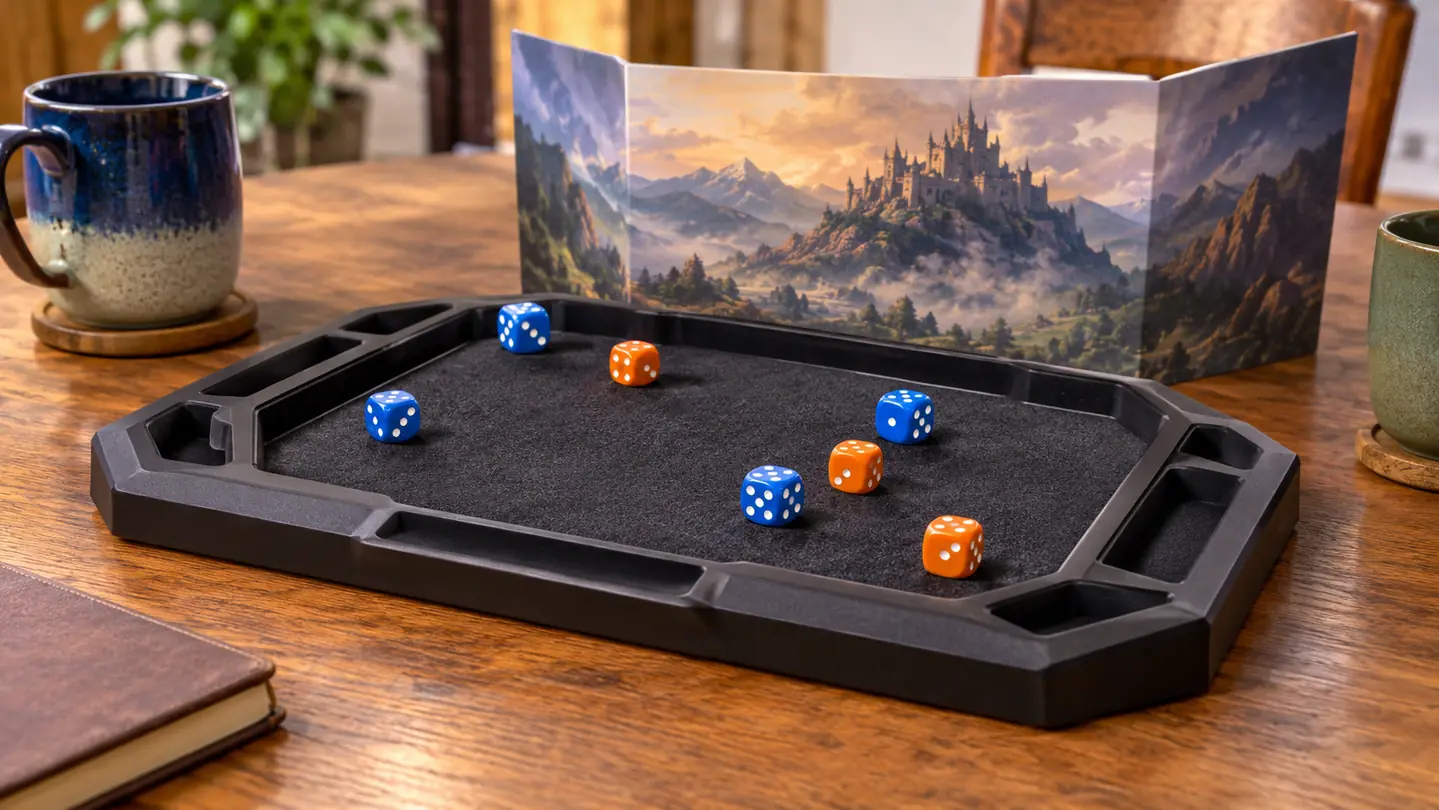
Sky Team is two players, listed twelve and up, and it is a dice game at heart. In the box you get a control panel, an airplane axis disc, eight dice, two player aid screens, an altitude track, and the approach setup. There is a set of twenty airport scenarios, and each one has its own layout and its own special rules, so it is not the same landing twenty times over. Scorpion Masqué put this out in 2020 and it took Game of the Year in 2024, which is a strange and rather nice gap.
The weight on the listing is a hair over half a kilogram, and the whole thing is cardboard and dice in a box that would fit under a car seat. It is listed as travel sized. Ours has never gone anywhere, so I can only tell you it would fit.
The optional modules are the part you grow into. Kerosene leaks, ice on the tarmac, a rookie intern who needs extra guidance. We have tried modules a couple of times, and both times we went back to a plain airport the following Friday. That is not a complaint about the game. That is a confession about us.
The two player aid screens matter more than they look like they would. They stand up between us, one in front of me and one in front of Hal, and once they are up neither of us can see the other's side of the table. The first time I set them out I thought they were fussy. By the third Friday I understood. That little cardboard wall is the whole reason the game works, because it turns a board game into a conversation where you have to trust what the other person tells you rather than checking it yourself. Hal cannot lean over and look at my side. I cannot look at his. We have to talk, and we have to be honest, and if one of us gets it wrong the plane comes down.
How It Actually Plays, Night to Night
You and your co-pilot are landing a plane. That is the whole premise, and it holds up because the game keeps putting you in spots where you have to say something out loud that you would rather not say.
The pressure is communication. The pilot does not have the same information the co-pilot has, and the co-pilot is not allowed to simply tell the pilot everything. So you get a lot of, I need you to take that one, and the other one going, are you sure, and both of you staring at the control panel like it might change its mind. On our bad nights that is a small argument. On our good nights it is the most conversation we have had all day.
The honest tradeoff is that Sky Team is unforgiving in a way that can sting. We have had landings that were not savable by the time we saw the problem. Two of the eight airports we have flown took multiple attempts, and one of them has beaten us five times now and counting. When it goes badly it goes badly in about fifteen minutes, which is the saving grace. You can lose and immediately set up and go again, and you will want to.
Let me give you one night in particular. It was a Friday in September, the second week of the month, and we were on our third go at the airport that has been giving us fits. We had gotten further than ever. There is a point in that landing where the plane is down low and everything has to line up at once, and we were one good roll away from being home. Hal was co-pilot that night, which is a swap for us, and he said, alright, I am going to ask you for something and I need you to say yes. I said yes. It was not the roll we needed. We came down about the length of our driveway short of the runway, or that is how it felt, and we both sat there for a second. Then he laughed, and I laughed, and we set it up again. That is what this game is. It is twenty-five minutes of leaning over a table with somebody, and sometimes you get in and sometimes you do not.
One more thing about the pace. There is no downtime in Sky Team, because you are never waiting on the other person to finish a turn. You are both in it the entire time. That sounds like a small thing until you compare it to a game where one player takes three minutes to decide something and the other one is looking out the window. At our table, after a long day, that matters.
Under half an hour, twenty airports, and a difficulty that climbs. Six months in we have flown about eight of them. That is a lot of game still in the box.
Six Months of Fights and Landings
The first three weeks were the honeymoon, which is true of every game. The test is month three. Around August we went through a stretch where we lost five attempts in a row across two Fridays, and I said out loud, I do not want to do this tonight. So we didn't. We played Jaipur, Hal won, and the next Friday we came back to Sky Team fresh. A game that survives being put down for two weeks is a game worth keeping on top of the basket.
What surprised me is that the losing is not the part that wears on you. The part that wears on you is the middle of a landing, when you can see that a choice you already made two rolls back is going to cost you and there is no undoing it. Early on I would get quiet when that happened. Now I say it out loud, and Hal says, well, let us see if we can get out of it, and sometimes we do. That small exchange is worth more to me than the wins. I did not expect to be writing that sentence about a game with dice in it.
One thing I did not expect: my flying has gotten better and so has his patience. Hal is not a patient man by nature. Early on he would get short with me when a landing went sideways, because in a competitive game that is what you do. In Sky Team there is nobody to blame. If we go down, we both went down. Around the fourth month he started saying, alright, that one is on me, when he made a bad call. I have lived with him thirty-one years and I do not hear that often.
What has worn thin: setup takes a few minutes once you move past the plain airports, and when we are tired that is the difference between playing and watching television. The components are cardboard, and cardboard shows every bit of handling. Our control panel has a slightly soft corner now from being picked up a few hundred times. It still works fine. It just looks handled. The folks at Scorpion Masqué built a sturdy little box, but it is not a fancy one, and after six months of Fridays you can tell.

Where It Falls Short
Two things I would tell a friend before she buys it.
First, this is not a talking game. Do not buy it expecting to learn something new about your husband. You will learn how he handles pressure and whether he trusts your judgment, which is not nothing, but it is a puzzle you solve out loud rather than a conversation. If what you want is a real talk at the table, this is the wrong box. That is a different kind of evening and we have a different box for it.
Second, the difficulty curve is real and it does not come from the number of pieces. The plain early airports are gentle enough that a first-timer will feel clever. Then it tightens, and the options are to get sharper or to lose more often. Hal and I are fine with that. A couple who wants a relaxing hour of play will find the later airports more stressful than the television they were avoiding.
What I Liked
- Two players only, and you are genuinely on the same side from the first roll
- Games run under half an hour, so a bad landing costs you fifteen minutes and not an evening
- Twenty airports with their own layouts and rules, so there is a long runway of new content
- Teaching the base game took one evening, not two
- Hal and I went from a season of losing to landing most of the early airports
Where It Falls Short
- No talking-game value; it is a puzzle first
- Later airports get punishing, and one of ours has beaten us five times running
- Cardboard components show handling over time
- Setup on the module scenarios is enough friction that we skip it when we are tired
- Not the right pick if one of you hates being told what to do
Who This Is For
This is for a couple who likes being on the same team and has trouble finding a way to do that. If one of you is competitive and the other is not, that is the sweet spot. Hal needs a game to take seriously, and I need to not be beaten at a game by my husband on a Friday night. Sky Team gives him something to take seriously and gives me a partner instead of an opponent. Six months of Fridays says that arrangement holds.
It is also a good fit for the couple who stopped sitting at the table. That was us. After our daughter moved out in September of last year the house got quiet, and we slid into eating supper in front of the television without saying much of anything. Sky Team did not fix that. But it gave us a reason to clear the table and stay at it, and after thirty-one years a reason is most of the work.
And it suits a couple who wants something to grow into rather than something to finish. Eight of twenty airports in six months is slow, and I like it that way. There is a stack of landings we have not attempted sitting in that box right now, and two modules we have barely touched, and I am not in any hurry. A game you can still be learning in your second year is a better buy than one you solve in a weekend and never open again.
Who Should Skip It
Skip it if you want an easy, chatty hour. This game makes you think, and it will occasionally beat you for a whole evening, and there are couples who will find that tiring rather than fun. Skip it if either of you takes losing badly in a way that turns inward. Cooperative games do not remove tension; they move it, and in this one the tension lands between the two of you.
And skip it if you are looking for something to do the talking for you. Sky Team gets you talking about the plane. If the plane is not the conversation you were after, there are better places to spend the evening. I would not trade our six months of it, but I would also not have wanted it to be the only thing on the sideboard.
Eight airports flown, twelve still in the box
Six months at our kitchen table and we are not close to finished. Two players, twelve and up, and the Friday slot is already spoken for.
Amazon Check Today's Price on Amazon →