
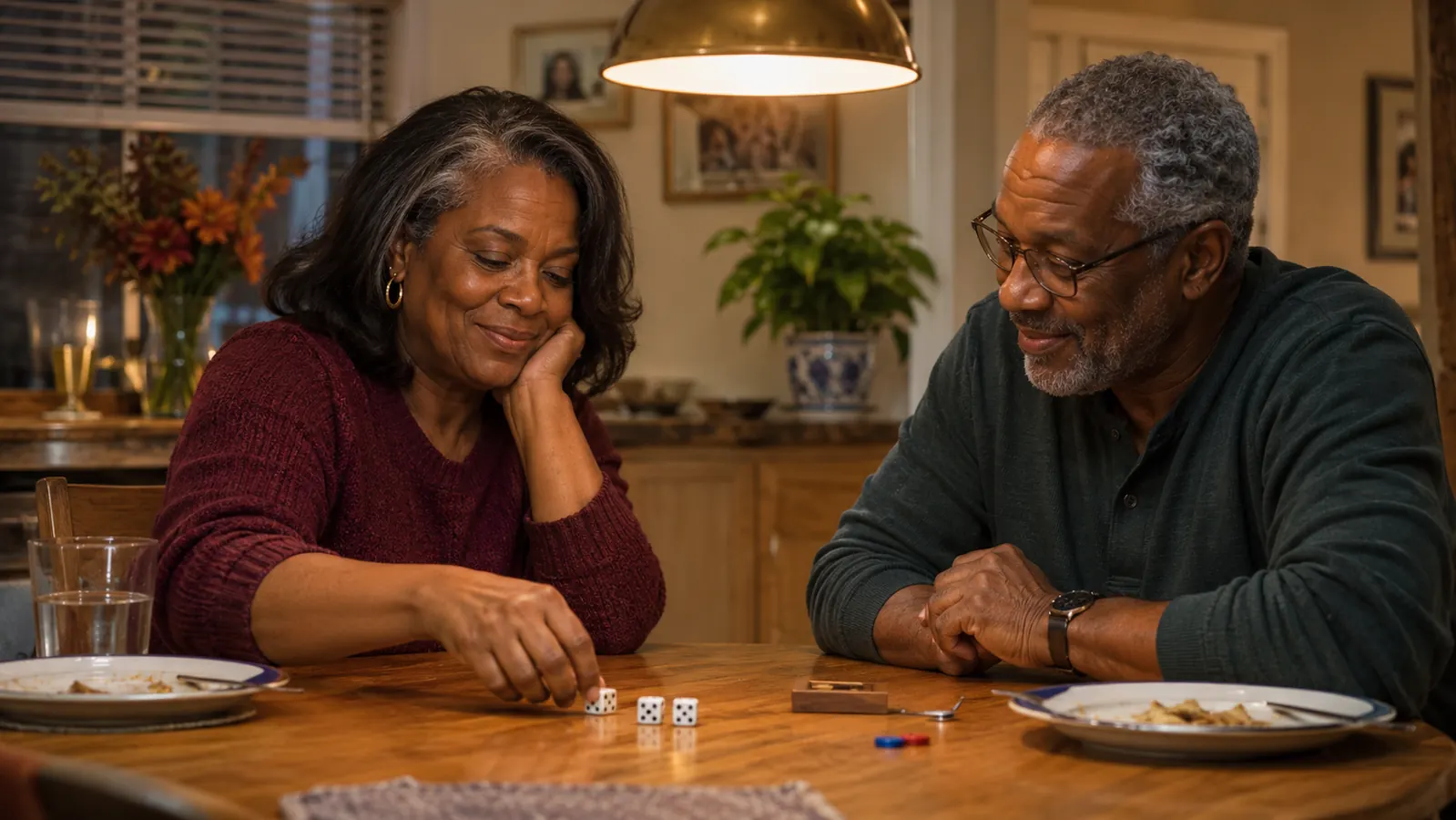
The house got quiet in a way I did not see coming. Our daughter moved out in September of last year, and about six weeks later I noticed that Hal and I were eating supper with the television going in the other room and not saying one word to each other that was not about the mail, the truck, or whether the trash had gone out. Thirty-one years married, and we had gotten out of practice at talking. I am not going to sit here and tell you a board game fixed that, because it did not. What it did was give us a reason to be at the same table at the same time, and that turned out to be most of the fight.
We started with a competitive game, Jaipur, in March. Hal likes it fine and he wins a little more than half the time, but on a bad night losing makes him quiet in a way that follows him to the couch. What changed our Fridays was Sky Team, from Scorpion Masqué. Two players, pilot and co-pilot, landing a plane together. Nobody wins. You land or you crash, and either way the two of you did it side by side. That one difference, more than any rule inside the box, is why we can play it on a night when one of us is tired and cranky and still come out of it speaking to each other.
I am not a counselor, and Hal and I have never sat down with one. What follows is just what worked at our round oak table in Tyler, in the order I would tell a friend who asked me about it after church.
One box, two people, the same side of the table
Sky Team is the cooperative one. A bad roll is something the two of you solve together, not something one of you did to the other. Six months in, it is still the box we reach for on Friday.
Amazon Check Today's Price on Amazon →Step 1: Pick the night before you pick the game
Our first mistake was playing whenever we got around to it, which is a polite way of saying never. A game that lives on a shelf waiting for a free evening will wait a long time. There is always a load of laundry, always something recorded on the DVR, always a good reason to put it off until tomorrow. After about two months of that I figured out that we were not going to find a night. We were going to have to pick one and then defend it.
Friday is Sky Team now. Not every Friday, because life happens, but most of them. Hal gets home around 5:30, supper is about 6:30, dishes are done by 7:15, and we start around 7:30. It is on the calendar in pencil, and if one of us is too tired we say so at supper instead of at 7:30 with the box already open and the other one quietly irritated.
Naming the night does something a general intention does not. It gives you a thing to protect. When somebody at church asks Hal to help move a refrigerator on a Friday evening, he has a reason to say no that is not just that he does not want to. Thirty-one years in, a standing date with your own husband sounds like a small thing, but it is a thing, and small things are what a week is actually made of.
Step 2: Clear the table down to the game
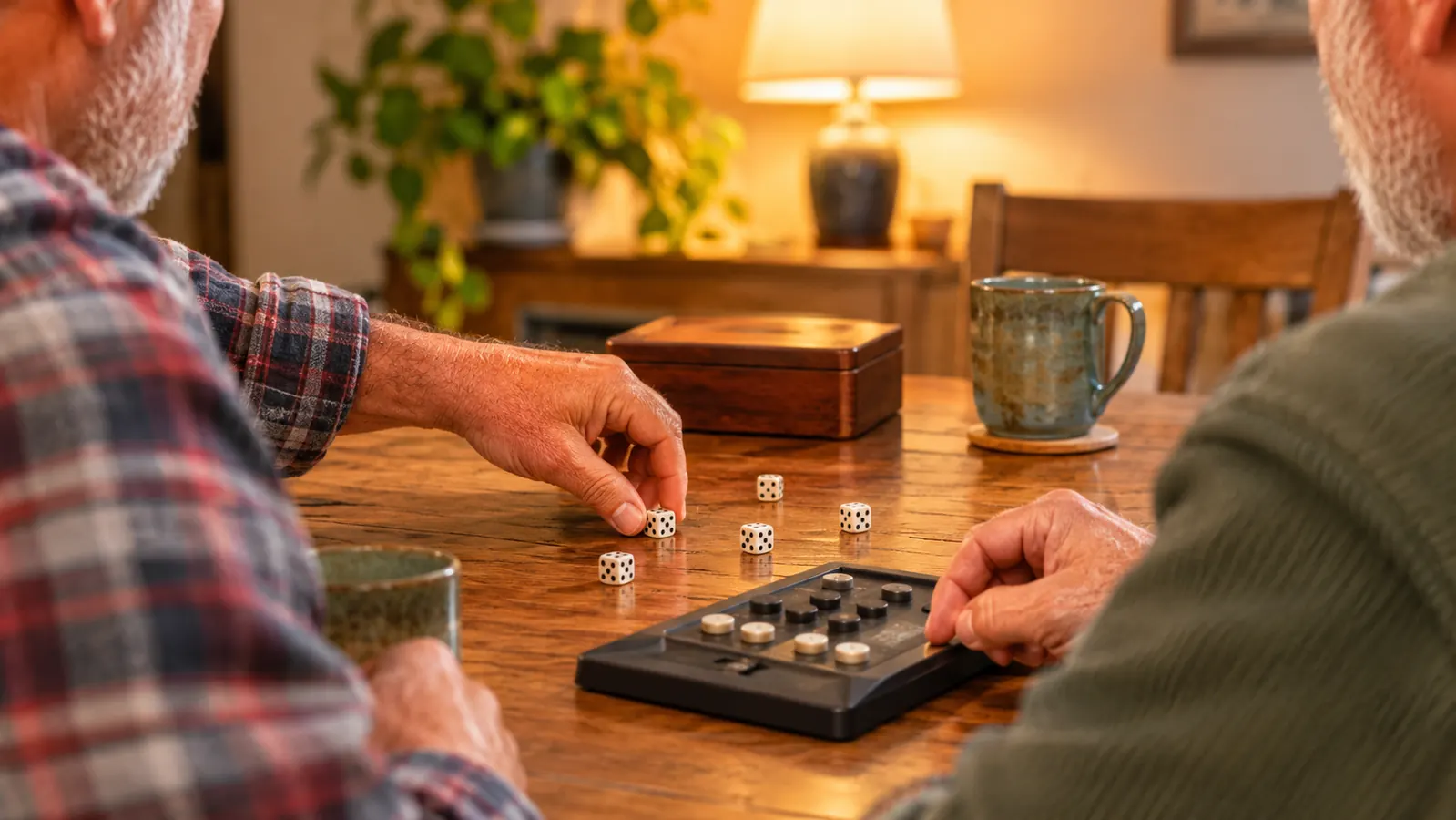
The oak table is where the mail goes to die. Before we play, all of it comes off. The bills, the flyer from the store, Hal's reading glasses case, the salt and pepper, the stack of napkins that never gets put back in the drawer. A cleared table tells both of you that this is the thing you are doing now, and it takes about ninety seconds, which is the best return on ninety seconds I have found in a while.
Phones go to the other room. Not face down on the table, not on the counter where you can watch them light up out of the corner of your eye. The other room, on the charger by the door. We started doing this for the games and it has bled into supper, which was not the plan and was a welcome side effect. There is a difference between being in the same room and being at the same table, and the phone is most of that difference.
Sky Team, from Scorpion Masqué, does not need much room, which matters when your game table is also your supper table and you do not want to spend twenty minutes setting up. Eight dice, the control panel, the airplane axis disc, the altitude track, and the two player aid screens take up about the space of a dinner plate and a half. In good weather it also fits on the porch table, though we mostly stay in the kitchen where the light is better and the chairs are kinder to Hal's back.
Step 3: Learn it out loud together the first night
Do not read the rulebook in the other room and then come out and teach the game like a briefing. That is how you end up with one person who knows what is going on and one person who feels behind before the first die is rolled, and the second person does not have a good time. We read the rules out loud at the table, both of us, with the pieces in front of us and the book lying flat between our coffee cups.
We crashed our first three attempts that first evening and landed on the fourth, all of it inside about two hours, and none of it was a disaster. That is the whole benefit of a game where nobody wins. A crash costs you a shrug and a reset, not an evening. Hal does not like to lose at anything, and he did not sulk once. He was too busy trying to work out how to get the plane down with me.
There are 20 airports in the box, each with its own layout and special rules, and we have flown about eight of them. We are in no hurry about the rest, which is a nice thing to be able to say about a game six months in. There are optional modules too, things like kerosene leaks, ice on the tarmac, and a rookie intern who needs extra guidance. We have used one of those a couple of times and decided we like the plain game better on a Friday night. That is allowed. Nobody is grading you.
We crashed three times and landed on the fourth, all in one evening, and nobody had to apologize for anything.
Step 4: Agree on how you will talk before the dice hit the table
The arguing part of a game night almost never comes from the game. It comes from the tone. In a competitive game the question is why did you do that, and it lands like a judgment even when you did not mean it that way. In Sky Team you cannot win alone, so you learn to say what you need instead of what you think about your partner's last move. That is a skill, and like most skills it is awkward for the first week.
Our rule is three sentences. Here is what I have. Here is what I need. What do you have? That covers about ninety percent of a flight. Hal spends his workdays telling people what to do, and the hard part for him was to stop issuing orders and start asking questions. It took him until about the third Friday. Now he will say he needs a four on the speed and then wait, which sounds like a small thing and is not.
The other rule is no post-mortem while the plane is still in the air. If it is going down, we land it and we talk about it after. Rehashing a bad placement in the middle of a flight is how a pleasant evening turns into a thing you remember sideways, and we have had enough of those over thirty-one years to know better. A cooperative game is forgiving, but only if you let it be.
Step 5: End the night on purpose
We play one landing attempt, sometimes two, and then we stop, even if it went badly. Stopping while it is still fun is the whole trick. The first few weeks we played until we were tired, and the last game of those nights was never as good as the first, and the last game is the one you carry to bed with you. Now we quit while we are ahead, or at least while we are still laughing.
Afterwards, two questions. What went wrong in the air, and what are we doing differently next Friday. Two questions, not twenty. Anything past two turns into a review, and a review is not a date. If it was a good landing, we say so, and one of us usually mentions how the other one saw it coming before they did, which is about as close as we get to bragging on each other.
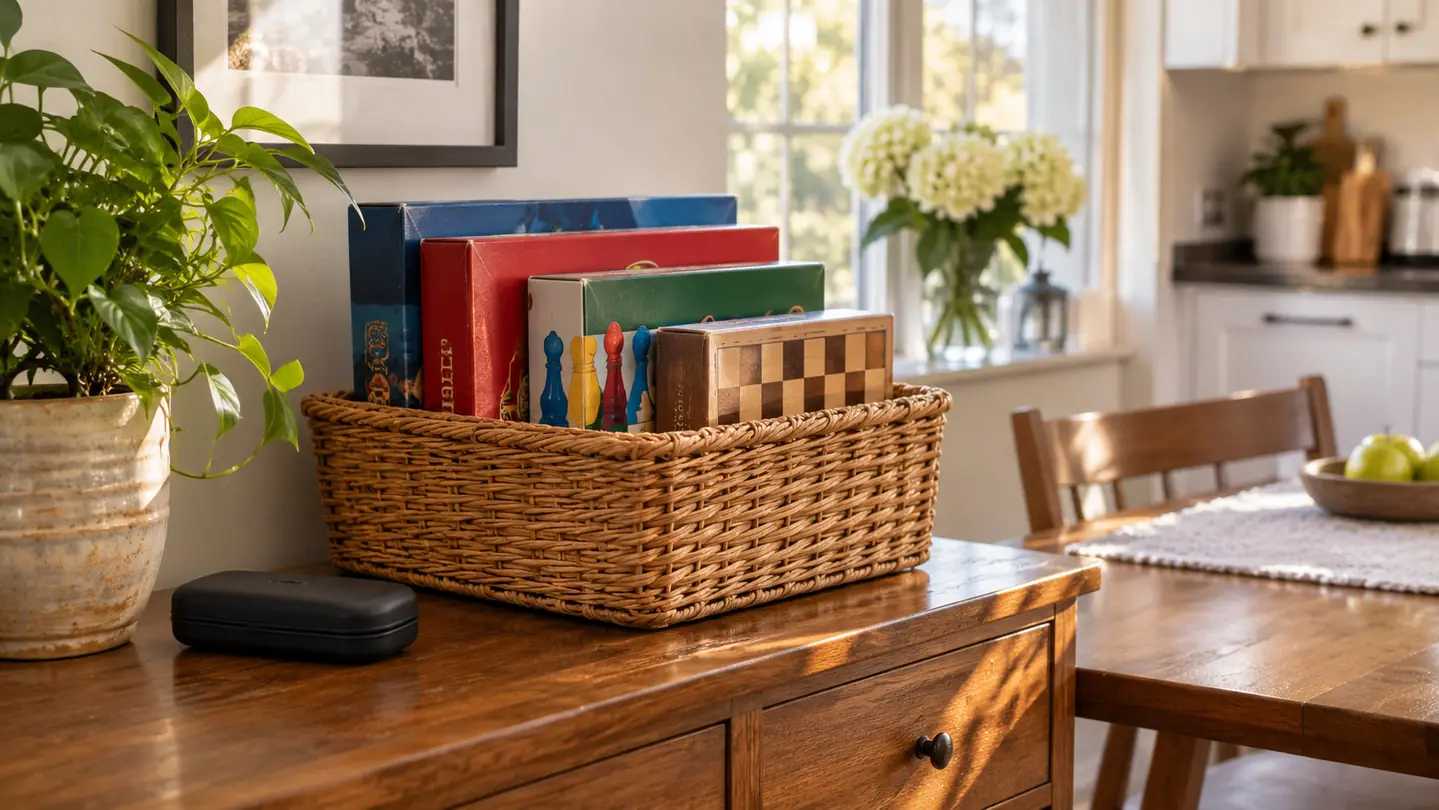
Then it goes back in the wicker basket on the sideboard with the other four boxes, one of us turns off the kitchen light, and that is the night. It takes about forty-five minutes start to finish, which is why it survives contact with a real week. A date that requires a reservation and a good mood does not happen in November. A date that requires a cleared table does.
What Else Helps
A cooperative game is not the only way to get two people talking, and it is not the right tool for every night. We have five boxes in that basket now, and the useful skill was working out which one fits which mood. Sky Team is for working together. Jaipur is for competing, and it is Hal's favorite, but we save it for nights when he has had a decent day. The Couples Game is the light one for when we are too tired for anything that asks much of us. The Deeper Talk deck is for Sunday, one card or two, about twenty minutes, and we skip any card either of us would rather not answer.
If your partner is set against the idea of games, the cards were the door opener at our house, not the board games. Hal refused the first two Sundays outright, sat through the third because I did not make a production of it, and by about the sixth week he was answering without being asked twice. Sky Team came after that, once being at the table together had stopped feeling like homework. That order mattered for us. Twenty minutes of questions first, then a game with dice and a rulebook. Your order may be different, and that is fine.
The box that ended the quiet Fridays at our house
Sky Team is a two-player cooperative game from Scorpion Masqué. One plane, one table, and a reason to be sitting across from each other at 7:30 instead of in front of the television.
Amazon Check Today's Price on Amazon →