

The quiet crept in. Our daughter moved out in September 2025 and I had braced myself for the empty bedroom and the extra space in the driveway. What I did not brace for was how loud the dishwasher would sound at 7:05 in the evening. Hal gets home from the hospital around 5:30, we eat at 6:30, and by 7:00 we were on the couch with the television on and the only words exchanged were about whether the trash needed to go out. Thirty-one years married, and we had stopped talking about anything that was not a chore.
I bought Jaipur in March 2026 for a calculating reason. Hal is competitive at board games in a way he is not competitive about anything else, and I am not above using that to get him to a table. Asmodee makes it, it is built for exactly two players, and the box says 30 minutes. That 30 minutes was the whole pitch. He works maintenance at a hospital all day and he was not going to sign up for a four-hour commitment on a work night. Eight months later Jaipur is still the Tuesday game in this house, and I have opinions about it, good and bad.
The Quick Verdict
The one game in our basket that got a quiet man to look forward to a weeknight. Two players, 30 minutes, and close enough that neither of us gets to coast.
Amazon Check Today's Price →Thirty minutes, two players, and a husband who stops watching the clock
This is the one that started our Tuesday habit. Built for exactly two players, ages 10 and up, about 30 minutes a match, and it took us two games to stop reading the rules out loud.
Amazon Check Today's Price on Amazon →How I've Used It
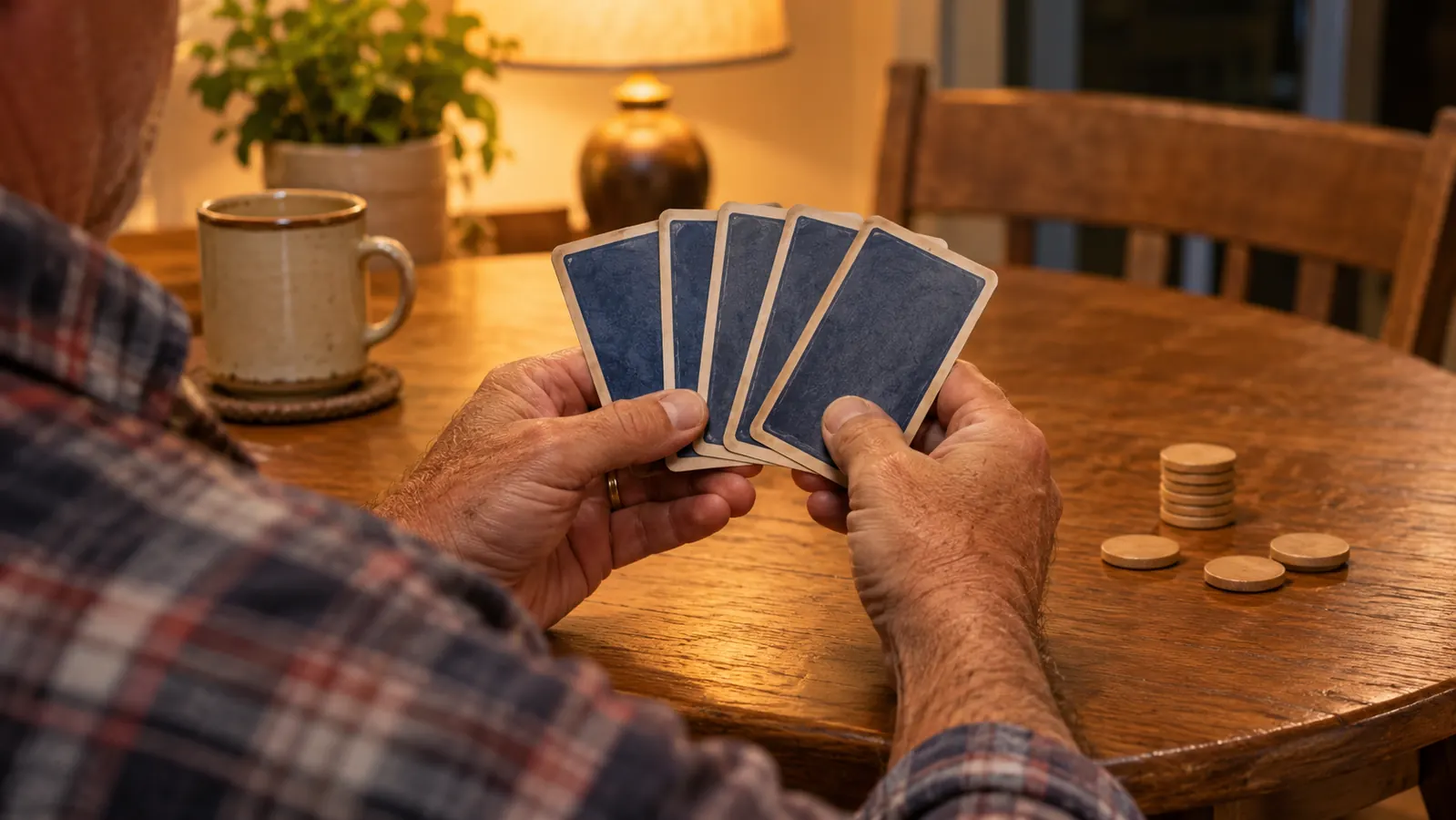
Our table is round oak, in the kitchen, and the dishes are usually done by 7:15. Jaipur comes out around 7:30. We play a match, which means rounds, and whoever takes two of the three seals wins the match. Most Tuesdays that is 30 to 45 minutes with the trading back and forth and one of us taking too long over a decision. There is nothing to unfold and nothing to plug in. You shuffle 55 goods cards, lay out the tokens, and you are playing.
The game itself is a market. Cards come out in a row, and on your turn you either take goods into your hand or you take the camels off the row. You sell sets of the same good for tokens. Leather, spices, cloth, silver, gold and gems are the six goods and they do not pay the same. There are bonus tokens for selling a pile of one thing at once. Written out like that it sounds like a lot of arithmetic. It is not. Hal had the whole thing by the second game and he is not a man who reads rules for pleasure.
The first two games we kept the folded rules sheet on the table between us and checked it most turns. By the third Tuesday we did not need it and I put it back in the box. That was the honest learning curve for us, about an hour of fumbling. Our son picked it up inside a single round when he visited. The box says 10 and up and I would not argue with that.
The Rules Take Two Games, Not Two Hours
I want to be plain about the setup, because setup is what stops people. There is no app, no timer, no screen, no account to make. You shuffle, you deal, you lay out the market and you go. The whole teach fits on one page, and Asmodee kept it to one page, which I appreciate at my age. Take cards or sell cards. That is most of it.
The camel token confused me for one solid evening. Camels are not a good you sell. They sit in their own pile and you take the whole pile into your hand, and at the end of the round the camels you are still holding count for a little something. I kept trying to sell mine. Hal, who had read the same single page I had, watched me do it wrong twice before he said a word, which tells you a good deal about the man I married.
The one rule worth reading twice is how a round ends, because it sneaks up on a beginner. Certain goods tokens run out and the round is over, sometimes while you are still building toward something. I lost a round in April because I did not see it coming. It is not a flaw, it is the clock of the game, but you will want to know it before your first match.
What Eight Months of a Close Score Looks Like
Hal wins a little more than half the time. Not by much. Just enough that the tally in his head stays satisfying to him and I stay irritated enough to want a rematch. That ratio is why this game punches above its weight in our house. A game where I won most nights would have lost him by summer. A game where he won most nights would have lost me. Jaipur stays close because the tokens pay better for selling a big set early and worse later, so timing matters as much as the cards you draw.
There was a Tuesday in September that I still bring up at supper. Hal was one card away from a bonus token and I could see it as plain as the salt shaker, so I took the card he needed off the market and sold my cloth instead. He did not say a word for the rest of that round. Then he took the round anyway on a gem sale I never saw coming, and he grinned at me over his coffee cup for a solid minute without speaking.
There is luck in it. Cards come out in an order neither of us controls, and some Tuesdays the market hands Hal exactly what he needed three turns running. I have had to learn to let that go, and I am not fully there yet. What I will say after eight months is that luck has not decided our score. The decisions have. That is the difference between a game we still play every week and a game that lives in a basket.
Hal wins a little more than half the time, which is the exact ratio that keeps a competitive man at the table and a stubborn woman asking for a rematch.
What It Changed Around Here
I am not going to tell you a card game saved my marriage. Nothing was broken. We were quiet, the quiet had gotten comfortable, and comfortable is how two people end up thirty-one years in with nothing to say between the evening news and bedtime. What Jaipur did was give us a reason to sit three feet apart with something in common to look at. That is a smaller claim than it sounds and also a bigger one.
I tried the other way first. In the spring of 2026 I sat down with a spiral notebook and wrote out twelve date nights, numbered, with the idea that we would work down the list. We got through three of them. By the third week I was the only one looking at the notebook and it had turned into one more chore with my handwriting on it. Jaipur asks nothing of me except to shuffle and deal.
The change is not the game. The change is that Tuesday is spoken for now. Hal asks about it. He never asked about television. He comes in from the porch around 7:20 and says something about getting beat, and I go get the box out of the wicker basket on the sideboard. The talking happens around the game more than during it, but it happens. I did not need a deep conversation, as it turns out. I needed a reason to be in the same room with the television off.
What I Liked
- Built for exactly two players, so nobody is waiting a turn and nobody drifts off to a phone
- About 30 minutes a match, which fits a work night after the dishes
- We needed two games to learn it, then never opened the rules again
- Close enough that a competitive person stays interested and a stubborn one keeps asking for a rematch
- Small box, small footprint, nothing to unfold and nothing to charge
Where It Falls Short
- Two players only. It is not a family game and it is not a party game
- Some nights the card market decides a round before you get a fair turn
- Losing badly puts Hal in a mood, and this game can produce a bad loss
- A lot of small tokens to keep track of, and we have lost track of one twice
Where It Falls Short
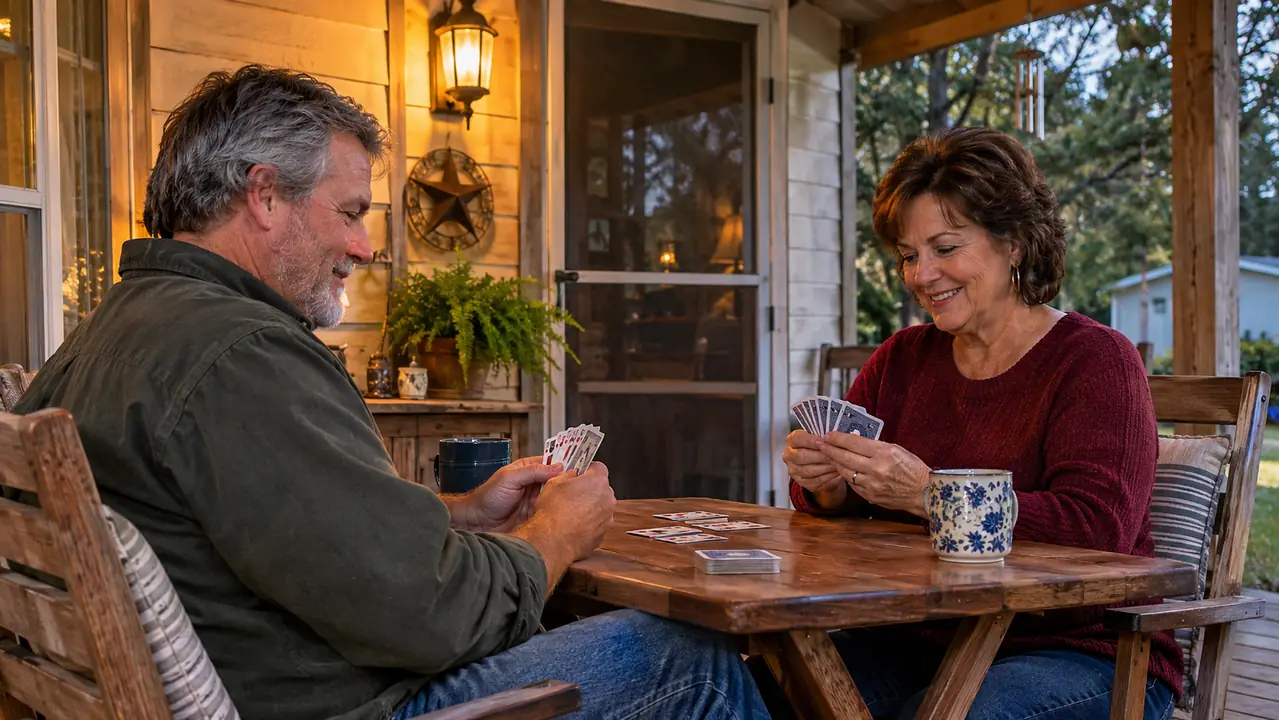
The two-player limit is the real one. If there is a third person in the house who wants in, this is not the game to reach for and no amount of good humor fixes it. We have other things in the basket for those nights. It is also not a talking game. If what you actually want is a conversation, Jaipur will not start one for you, and I would be lying if I said it did. It is a game you play, not a deck you draw from.
The other shortfall is temperament. When Hal loses badly, and it happens, he goes quiet in a way that is not fun to sit next to. We had one Tuesday in July that ended early. Our fix is simple. We play one match and stop, win or lose, and we do not play it on a night he has had a bad day at the hospital. If you are married to someone who genuinely cannot lose, this game will find that out about them, and it will not be the game's fault.
The pieces are small. There are a good many tokens in that box, and one spent a week under the refrigerator before I found it. The Asmodee box is compact, roughly half a pound, which is why it lives on the sideboard with everything else instead of in a closet. But small is small, and a house with a toddler in it will want to count the tokens before they go back in the box.
How It Stacks Up Against the Rest of Our Basket
We have five things in that wicker basket now and they do different jobs. Sky Team is the cooperative one, two players landing a plane together, and it is the answer on a night when competing would go badly. The Couples Game is the light one, the tin with the dry-erase boards, and it is for laughing. The Deeper Talk cards are for the Sundays when we want to actually talk. Jaipur is for the nights Hal wants to win something. The scratch-off date cards get us out of the house.
Sky Team is the one I would hand a couple who bicker, and I say that with affection. We crashed our first three attempts at landing that plane on the very first evening and laughed at all three, which is not something I can say about a bad Jaipur loss. But Sky Team does not scratch the same itch. Hal wants to beat somebody now and then. A cooperative game gives him a win we share. Jaipur gives him a win he can hold over me until the next Tuesday, and those are two different evenings at the table.
If you are weighing it against another two-player card game, the honest comparison is Lost Cities. I have played it twice at my sister's house and never bought it. It is quieter, two people doing their own arithmetic side by side, and it does not have the meanness. Jaipur has back and forth because the market is shared. You can see what your husband is collecting and take it before he gets there. That is what makes it work for us, and it is also what makes him sulk. I have looked at Let's Get Deep online and read the listing more than once. I have never owned it and never played it, so I will not tell you how it plays.
The cheap small-talk deck our daughter gave us in late 2025 is not in the basket anymore. We used it up in a few weeks because every question stayed on the surface. Jaipur has lasted eight months because there is always another match in the box. That is the whole difference between a thing you do twice and a thing that becomes a habit.
Who This Is For
This is for a couple who already like each other and have run out of reasons to sit down. It suits a competitive person and a patient one, in either order. It suits a work night, because 30 minutes is a real number and you can finish a match before the local news. It suits anyone who tried a question deck and found it too heavy for a Tuesday, and it suits a house with older kids, since the box says 10 and up.
It is also for whoever does the planning. I am the planner in this house and I was tired of being the one who had to come up with an idea every week. Jaipur ended that. The idea is in the box, it is the same idea every Tuesday, and nobody has to be creative about it at 7:00 in the evening.
Who Should Skip It
Skip it if you need a game for more than two people. Skip it if you want the game to do the talking for you, because it will not. Skip it if your spouse genuinely cannot lose without a mood, since you will find that out on a Tuesday and it will not be the game's fault. Skip it if you are looking for something to fill a whole evening, because 30 minutes is what it is. One match and it goes back in the box, and that is the right amount.
Our Tuesdays are spoken for, and it took one small box to do it
If the quiet has gotten comfortable at your table, this is the simplest way I know to put something in the middle of it. Two players, ages 10 and up, no screen, and a match short enough for a work night.
Amazon Check Today's Price on Amazon →