

The short answer first, because that is what you came for. If you want a two-player card game that gives the two of you something to needle each other about, buy Jaipur. If you want a game that feels closer to working a puzzle in the same room as your partner, buy Lost Cities. Both are made for exactly two players. Both run about half an hour. Both are small enough to leave on the sideboard between suppers instead of packing them away in a closet.
I am not a neutral judge, and you should know that going in. There is a box of Asmodee Jaipur on my sideboard right now, eight months after we bought it, and my husband Hal asks for it most Tuesdays without me bringing it up. Lost Cities I have played exactly twice, both times at my sister's table, and I have never ordered it. That is the whole confession. One of these games has been played to pieces in my house. The other one I admire from across the room.
| Jaipur | Lost Cities | |
|---|---|---|
| Time to learn | You take cards or sell a set. Two games in, we stopped checking the rules. | You open an expedition and lay the next card. The rule sheet is about a page. |
| Play time | About 30 minutes a game, start to finish. | The same half hour, spread over a few rounds you score as you go. |
| Number at the table | Two players, ages 10 and up. There is no third chair. | Two players, and only two. Same story. |
| Luck against planning | Market timing and hand management. You decide when to sell before the tokens run thin. | Long-odds commitment. The earlier you commit to an expedition, the more it can pay or cost. |
| What losing feels like | You can usually see the exact trade that beat you. | Points you were counting on can sink in the final round. |
| Tidying up | 55 goods cards, 38 goods tokens, 18 bonus tokens and a camel token to sort back into the box. | One deck. Shuffle, stack, done. |
| Talking during play | Constant, because the whole game is reading your partner and running your mouth. | Quiet, because each of you is studying your own hand. |
| Tension at the end | The camels and the bonus tokens decide the close ones. | One last card can flip an entire expedition. |
| How often it got played | Eight months in, still our Tuesday game. | Two afternoons at my sister's. I would happily play a third. |
| Best for | A couple that wants a reason to be competitive with each other. | A couple that wants a patient puzzle and does not need chatter. |
| Age on the box | 10 years and up. | 10 years and up. |
Where Jaipur Wins
Jaipur wins on the thing that actually keeps a game on the table in a long marriage. It gives you a reason to pay attention to your partner. You are rival merchants in Rajasthan, buying and trading leather, spices, cloth, silver, gold and precious gems, and you earn rupees by selling sets at the moment the market is still rich. That is the whole game. The box holds 55 goods cards, 38 goods tokens, 18 bonus tokens, a camel token and the seals. It says two players, 30 minutes, ages 10 and up, and it means all three of those things.
The camels matter more than they sound like they would. You take them in a clump and they free up your hand, and then you have to decide whether to spend that room on more goods or on one more card you might need later. That is the hand management part, and it is where Hal is quietly better than I am. I play by feel. He plays by counting the tokens still sitting in the middle of the table. He wins a little more than half the time, which is about the right amount for a couple that wants to keep playing.
It took us two games to stop checking the rules. The first Tuesday in March I kept the folded rule sheet propped against the salt shaker and read it aloud twice, and we still had to stop and recount the tokens at the end. The second week we got through a whole game and only looked at the sheet once, over the bonus tokens. By the third week we were arguing about the game instead of the rules, which is the sign that a game has landed. That is a fast ramp for a card game, and it is the reason I stopped feeling like I was hosting a lesson and started feeling like I was playing.
What surprised me is how much talking it produces. I thought a card game would be a quiet activity, the two of us sitting there like we were doing a crossword. Instead I am watching what he collects and selling cloth early to spoil his set, and he is doing the same thing back to me. There was a Tuesday in September when he sold silver on his second turn and I spent the rest of the game trying to work out what he was up to. He was thinning his hand to take camels early. He beat me by a wide margin and then explained it to me at the sink while I washed the cups, which is the most conversation we have had over a game in years.
One practical thing in its favor: the whole box weighs 231 grams, which is nothing. It lives in a wicker basket on my sideboard next to the table, and getting it out takes about the time it takes for the kettle to heat. That matters more than people admit. Games that are a chore to unpack do not get played, no matter how good they are. This one gets played.
He wins a little more than half the time, which is about the right amount for a couple that wants to keep playing.
Where Lost Cities Wins
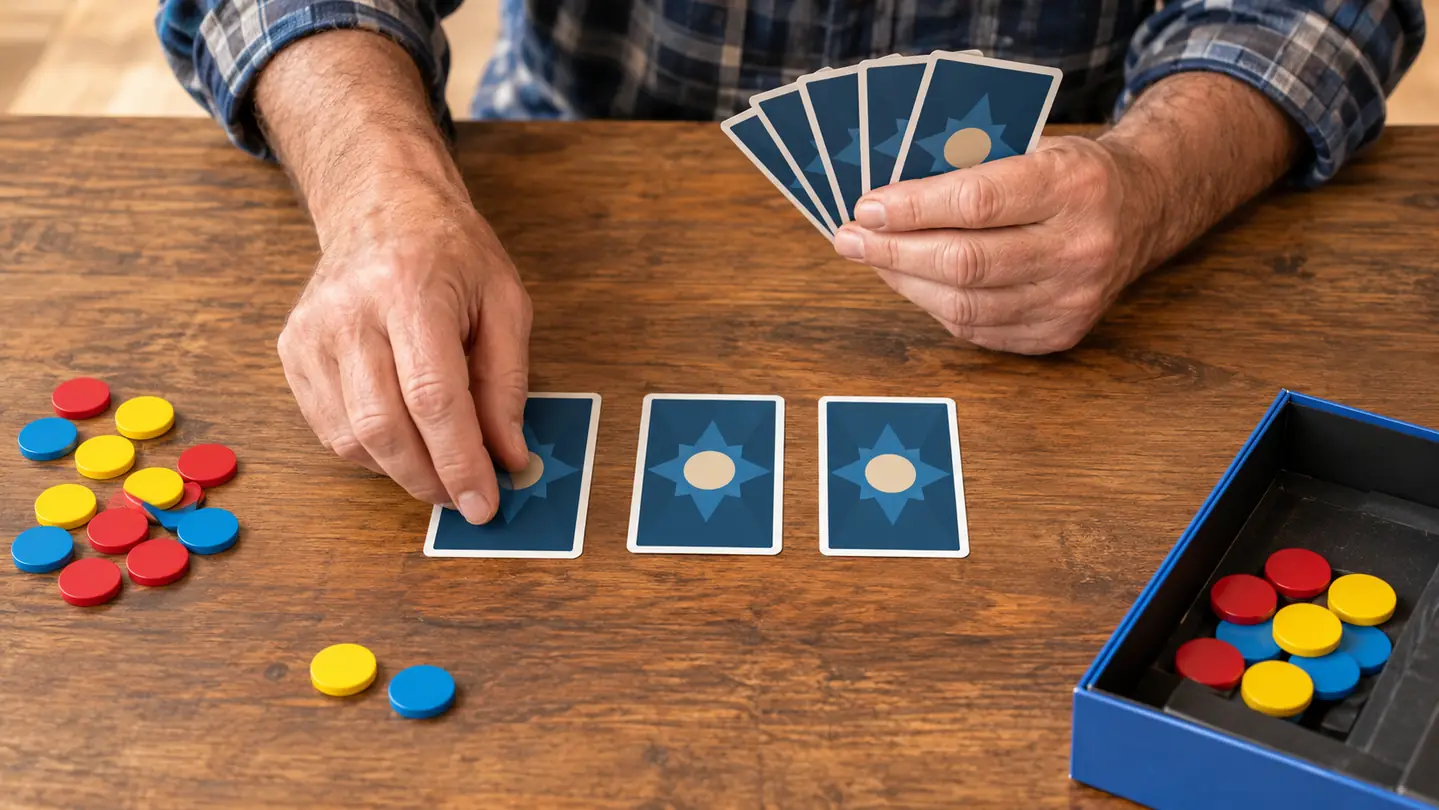
Lost Cities wins on the teaching, and it is not close. My sister handed me the deck at her kitchen table and had me playing in about four minutes. You open an expedition by laying a card down, then you add to it in ascending order, and the wager cards you put at the front multiply what that expedition is worth, either up or down. You play a few rounds and total your score. There are five expeditions to choose from and you cannot do them all, so every turn is a small decision about what to give up.
There are no tokens to sort, no market to track, no pile of goods to count out at the end. One deck, shuffled, and you are playing. If you have ever wanted to try a game with a husband who groans at rulebooks, that is the one to hand him. It also takes up about as much table space as two plates, so it would travel well, which is more than I can say for most of what is in my basket. The second time I played was a Sunday afternoon in July, ceiling fan running, the deck already shuffled before I sat down. Two plays, months apart, and no relearning. I cannot say that about much in my basket.
It is also gentler. In Jaipur you are directly taking from your partner, or selling the exact set they were building, and they can see you do it. Lost Cities is more private. You are working your own expeditions and mostly hoping the card you need is still in the deck. If one of you takes a loss hard, that distance helps. You can lose at Lost Cities without feeling outplayed by the person sitting across from you, and for some couples that is the difference between a game night and a sharp word in the kitchen.
Here is the honest counterweight. After two plays I liked it and did not feel the pull to own it. Part of that is because Lost Cities can feel like two people doing separate puzzles in the same room. There is not much banter, because there is not much to banter about. Between turns you are both looking down. My sister and I barely spoke for twenty minutes, and it was pleasant, but pleasant and interesting are not the same thing. I would happily play it again at her house. I just never came home and thought about it the way I think about Jaipur on a Tuesday afternoon.
The Asmodee game that got my quiet husband to ask for a game night
Jaipur is the one that has been in the basket since March and still gets played most weeks. Two players, about 30 minutes, and enough market timing to keep a competitive man interested. Check today's price and see the current rating on Amazon.
Amazon Check today's price on Amazon →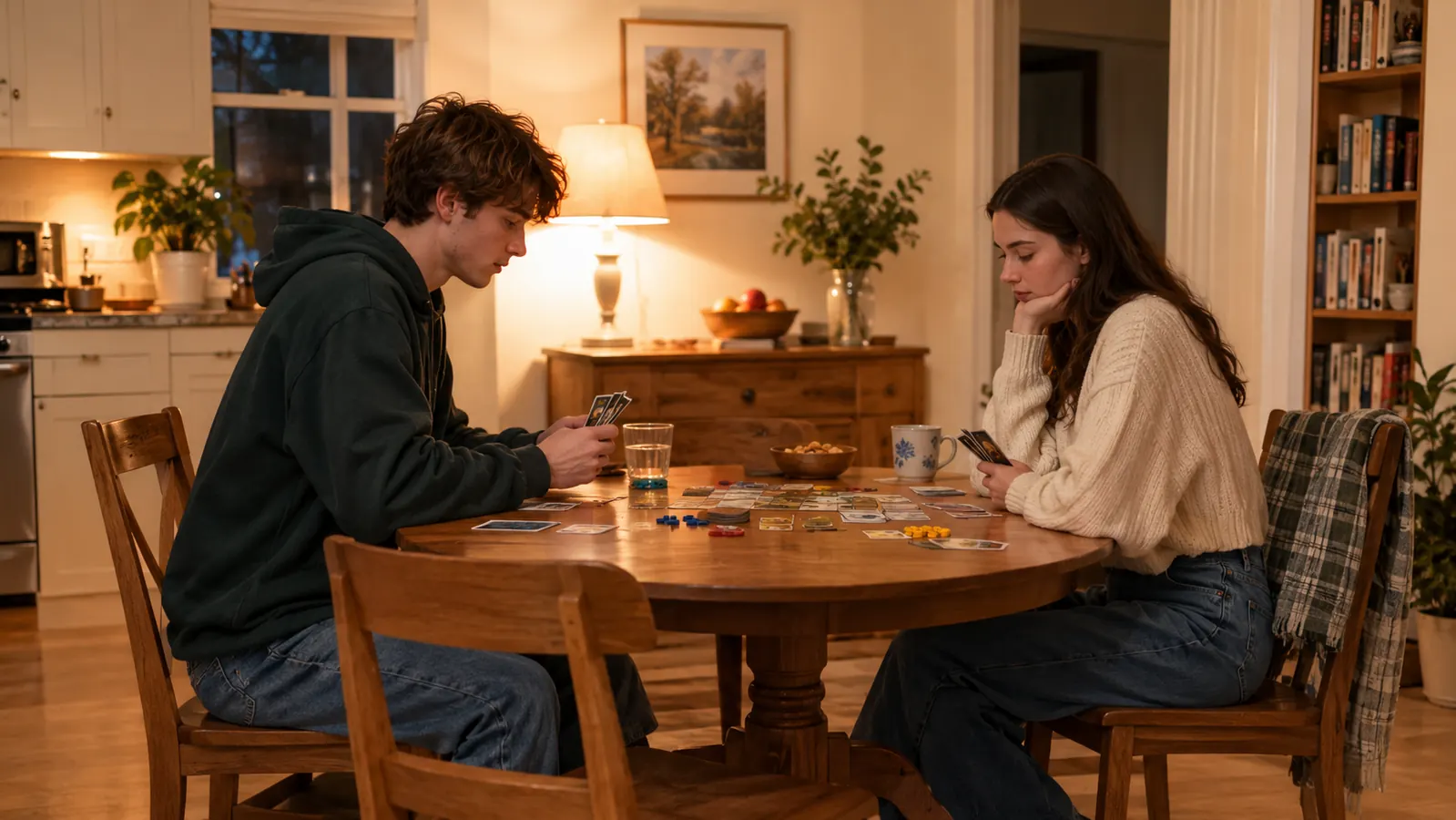
Who Should Buy Which
Buy Jaipur if at least one of you is competitive and the other one does not mind that. Buy it if you want a game that produces conversation rather than quiet, and if you have a spot where you can leave a small box out between suppers. Buy it if your partner is the type who says he does not like games and then quietly wins a little more than half the time. That was Hal, and the Asmodee Jaipur box is the reason he now sits down at the table on purpose.
Practically speaking, Jaipur asks one thing of you that Lost Cities does not: surface area. The tokens need room. At our round oak table that is nothing, but on a small apartment table with two plates still on it, you will want to clear first. Our routine is dishes, then the table wiped, then the box out of the wicker basket on the sideboard. It reads like a small thing until you skip it for a week and realize the game never came out at all.
Buy Lost Cities if one of you hates the feeling of being beaten directly, or if you want something you can teach in five minutes to a visiting couple, or if you want a game that fits in a bag. It is the better choice for a couple who wants a calm, low-talk half hour. It is also the better choice if a rulebook makes your partner leave the room. None of that is a small thing.
If you honestly cannot tell which camp you are in, ask this question: on a night when one of you is tired and a little short, do you want to be competing? If the answer is no, Lost Cities is the safer pick, and so is a cooperative game where you are on the same side. Our own fix for those nights has been a two-player game where we are landing a plane together instead of trading against each other. Nothing defuses a sharp evening faster than both of you crashing because neither of you rolled what you needed.
And if what you are actually after is talk rather than cards, neither of these is the answer. A card game will give you something to do together. It will not give you something to say. Our daughter gave us a cheap little question deck in late 2025, before any of this, and we burned through it in about three weeks. The questions stayed on the surface, the kind you can answer while the television is on, and once we had heard them all there was nothing left worth drawing. That is what sent me looking for a deck with more weight to it, and it is why I am fussy about them now. What I would tell you is that the games and the questions do different jobs, and most couples need both, and none of it works if the box stays in the basket.
One last piece of plain sense. Neither game is going to fix a quiet house by itself. What they do is give you a reason to be at the same table at the same time with nothing else going on. Jaipur did that for us because Hal likes to win. Lost Cities would do it for a couple who would rather think than talk. Pick the one that matches the two people you actually are, not the two people a listing describes, and then put it on the table this week.
Start with the one my house actually plays
Two players, ages 10 and up, about 30 minutes a game, and small enough to live beside the kitchen table. Jaipur is the Asmodee pick for couples who want a little competition with their conversation.
Amazon See today's price on Amazon →