
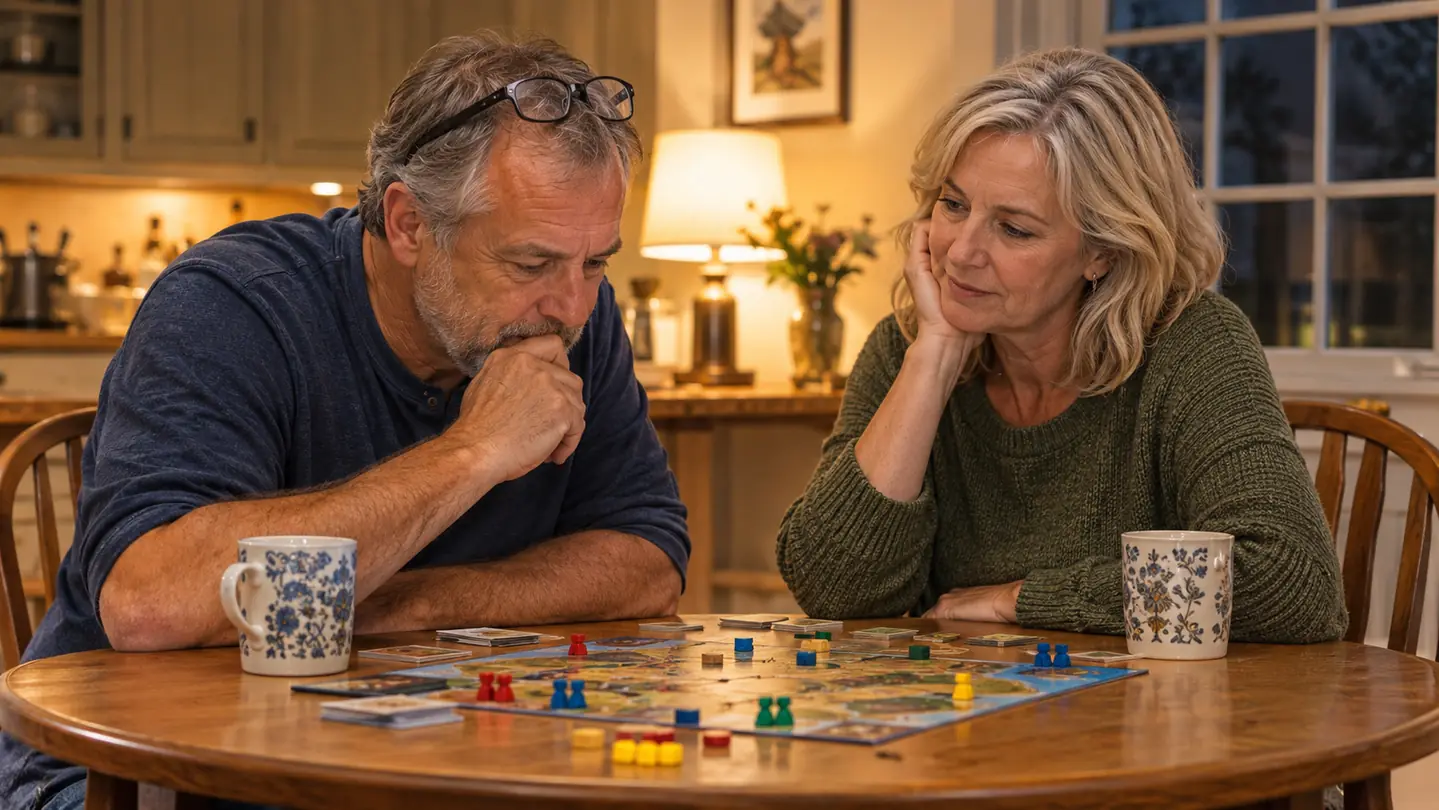
Sky Team is the only game in our house where my husband and I are on the same side, and that is the entire reason I bought it. Hal is competitive in a way that is mostly funny and occasionally not. When we play Jaipur he counts his camels twice and frowns at the cards I turn over. This takes all of that away, because there is nobody to beat except the airport. What nobody told me before I sat down with the rulebook is that being on the same side is not automatically restful. It is a different kind of work, and some nights it is harder work than competing ever was.
We bought it from Scorpion Masqué in May 2026. Six months in, we have flown about eight of the twenty airports in the box, and we have tried one of the optional modules a couple of times and then put it away again. We land more often than we crash now, but not by the margin I would like to admit. Hal is the co-pilot and I am usually the pilot, mostly because I am the one who reads rules out loud and he would rather not. This is not a review that tells you the game is perfect. It is closer to the review I wish somebody had handed me across the kitchen table before our first flight, because the hard parts are not the parts the box prepares you for.
The Quick Verdict
A short cooperative dice game that lands the plane and then asks two people to speak plainly to each other. Worth it, and not always comfortable.
Amazon Check Today's Price →If your game nights end with somebody sulking, start here
Two players, one plane, about fifteen minutes a run. Hal and I have been at it since May and it is still the game we set up on Fridays.
Amazon Check Today's Price on Amazon →How We Actually Play It
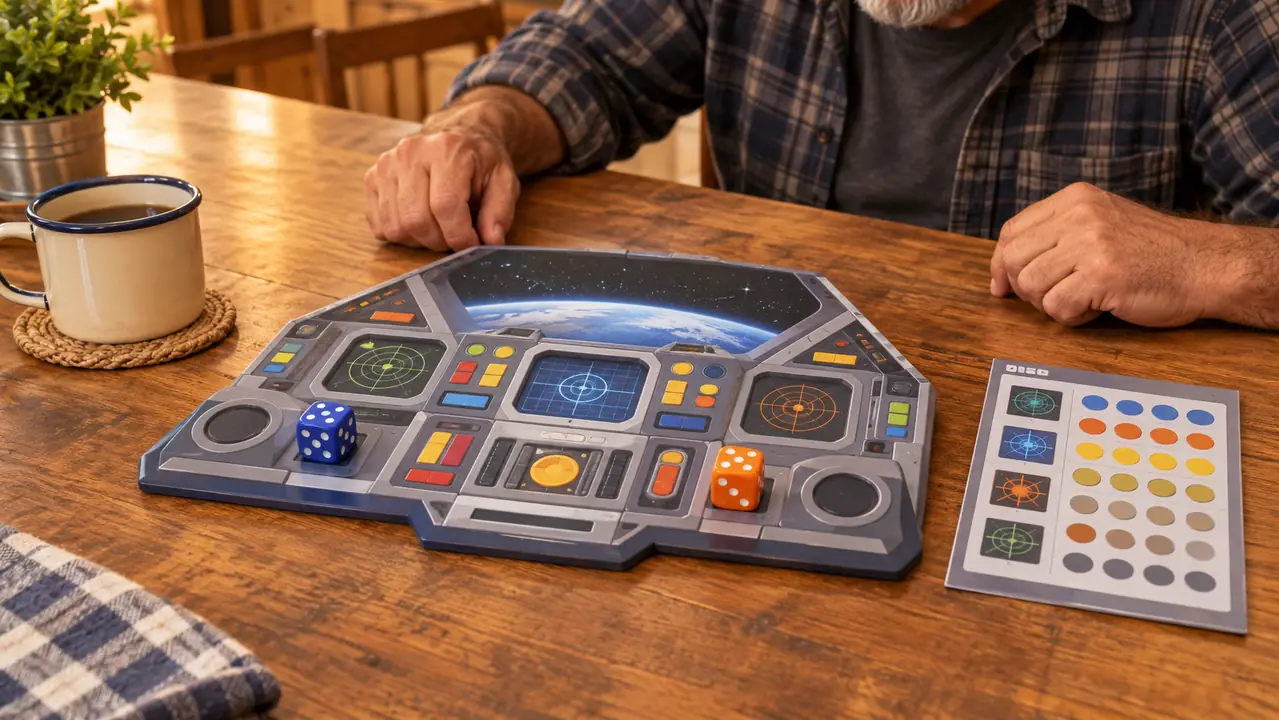
Friday is Sky Team night at our house. Supper is around six thirty, the dishes are done by seven fifteen, and somewhere near seven thirty I get the box down from the wicker basket on the sideboard next to the table. Inside there is a control panel, an airplane axis disc, an altitude track, an approach track, two player aid screens and eight dice. Setup is not a production. I can have the whole thing laid out before Hal has finished his coffee.
The first month we played it more than once a week, which is unusual for us. We were not good at it and that was the draw. There is a particular feeling that comes from losing a game together three times and then getting one right, and it is not the same feeling as beating your husband at cards. It is quieter than that. It is closer to the feeling of finishing something together in the yard before dark.
The premise explains itself in one sentence. You and your partner are landing a plane together. By the time the plane reaches the runway you have to have cleared the air traffic, adjusted your speed and levelled the wings, and you have to do it with the dice you actually rolled rather than the dice you were hoping for. Nobody is keeping score against anybody. The airport is the opponent, and the airport does not care whose fault it was.
Our first evening we crashed three times in a row and landed on the fourth. That sounds like a bad night and it was not. Each attempt ran about fifteen minutes, and every failure happened in a different place, which is what you want out of a cooperative game. A loss that teaches you something is worth more than a win that did not. We went to bed later than we meant to and I was still thinking about the approach track.
The Part That Is Hard on a Couple
Here is the piece nobody puts on the back of the box. The game restricts what you are allowed to say about the dice sitting in front of you. You cannot simply read your numbers out loud to your partner. You have to talk around them, describe what you can handle, ask for what you need, and then trust that the other person heard the thing you did not quite say. That is the whole game, and it is the whole difficulty.
Hal and I have been married thirty-one years. We have a private language made of half sentences, raised eyebrows and looks across a kitchen, and most of the time it works fine. It turns out that language is not nearly as precise as we believed it was. Our second Friday with this game was tense in a way that genuinely surprised me, because we were not competing and there was nothing at stake except a pretend aeroplane.
I would say something like, 'I can take the traffic if you handle the fast one,' and Hal would nod, and then we would both do something different and the plane would go down. After the third crash he said, 'you told me you had it.' I said, 'I did have it.' We meant different things by the word it. That is not a fight. It is a small thing. But repeat a small thing four times in one evening and it starts to feel like a pattern, and patterns are what couples of thirty-one years actually argue about.
There is a second layer to it that took me longer to notice. Because you cannot see your partner's dice, you spend the whole run guessing at what they are able to do, and some of us are better at being guessed at than others. Hal is not a man who explains himself twice. If I miss what he meant the first time, he goes quiet rather than repeating it, and quiet in a cooperative game is expensive. I have had to learn to ask again instead of assuming, which is not a skill I picked up in thirty-one years of marriage so much as one this box made me practise.
So this is the honest part of the review. Sky Team is not a game that makes a couple feel good about themselves. It hands you a task that requires plain speech, and if plain speech is something you two quietly stopped bothering with somewhere around year twenty, the game will show you that in a hurry. Around the fourth or fifth Friday we started saying the dull, obvious version of what we meant instead of the clever shorthand. The crashes got rarer. That was not the game changing. That was us.
We crashed three times on our first evening. On the fourth run we landed, and Hal said, 'say the plain thing first next time.' He was not wrong.
The Airports, the Modules, and Why We Keep Going Back
The box holds twenty airports, and each one has its own layout and its own special rules, so the same eight dice play out differently depending on where you are pretending to land. We have flown about eight of the twenty. Some are gentle and some are not, and I have learned not to pick a new one on a night when Hal has had a long day at the hospital.
The variety is the reason Scorpion Masqué put twenty airports in the box instead of five, and it is the reason this game has lasted six months in a house where most things get put away by the third week. A new airport is not a new game exactly, but it does force a new conversation. We flew one a few weeks back that had us talking about nothing but the angle of the plane for twenty minutes, and I could not tell you now what else happened that evening.
There are also optional challenge modules, and this is where I would slow a new couple down. The modules include a kerosene leak, ice on the tarmac and a rookie intern who needs extra guidance. They add difficulty in a way that also adds chatter, and chatter is exactly the resource you are already short of. We tried one a couple of times and put it back in the box. We are not steady enough at the base game to be handed an intern yet.
What keeps us coming back is that the game is short enough to lose without resentment. A bad run is a bad fifteen minutes, not a bad evening. We finish, we look at each other, and we either set it up again or we do not, and neither of those is a statement about the marriage. After thirty-one years I have come to value low stakes more than I used to. It was named Game of the Year in 2024 according to the box, and while an award does not land a plane for anybody, it does explain why so many people told me to try this before I did.
Six Months In: What Has Held Up and What Has Not
Six months of Fridays has not been gentle with the box. The components are cardboard and they have held up fine, which is more than I can say for the corners of the lid. The whole thing weighs a little over a pound and the listing calls it travel sized, though ours has never left the sideboard basket. Everything in our house happens at that round oak table or out on the covered porch, and none of these games has ever gone anywhere with us.
The rulebook is the part I would improve. It is not badly written, but the first read is dense, and we got two things wrong for the first month because we had skimmed a paragraph that turned out to matter. Once you have played three or four times the whole thing clicks and you stop opening it at all. The player aid screens do most of the work after that. Somebody at Scorpion Masqué clearly understood that people forget things between Fridays, and those aids are the reason we can skip two weeks and still sit down cold.
The other thing that has held up is the length. I have short patience for games that take an hour to set up and three hours to finish, and this is not one of those. We can play two runs and still be in bed at a reasonable hour on a work night, which matters when one of you is up at five for a hospital shift. I have never once looked at the clock and wished it were over.
What I Liked
- The airport is the opponent, so nobody has to lose to their own spouse
- A run takes about fifteen minutes, which makes a bad night short
- Twenty airports with their own layouts and special rules give it a long life
- Small and light enough to live in a basket beside the kitchen table
- Optional modules for later, including a kerosene leak, ice on the tarmac and a rookie intern
Where It Falls Short
- The talking restriction is genuinely hard for couples who run on shorthand
- The first three or four plays are more work than they are fun
- We got rules wrong for a month because the rulebook is dense on the first read
- The optional modules are too much for beginners
- Two players only, so it is no use for a family night
How It Fits With the Rest of Our Basket
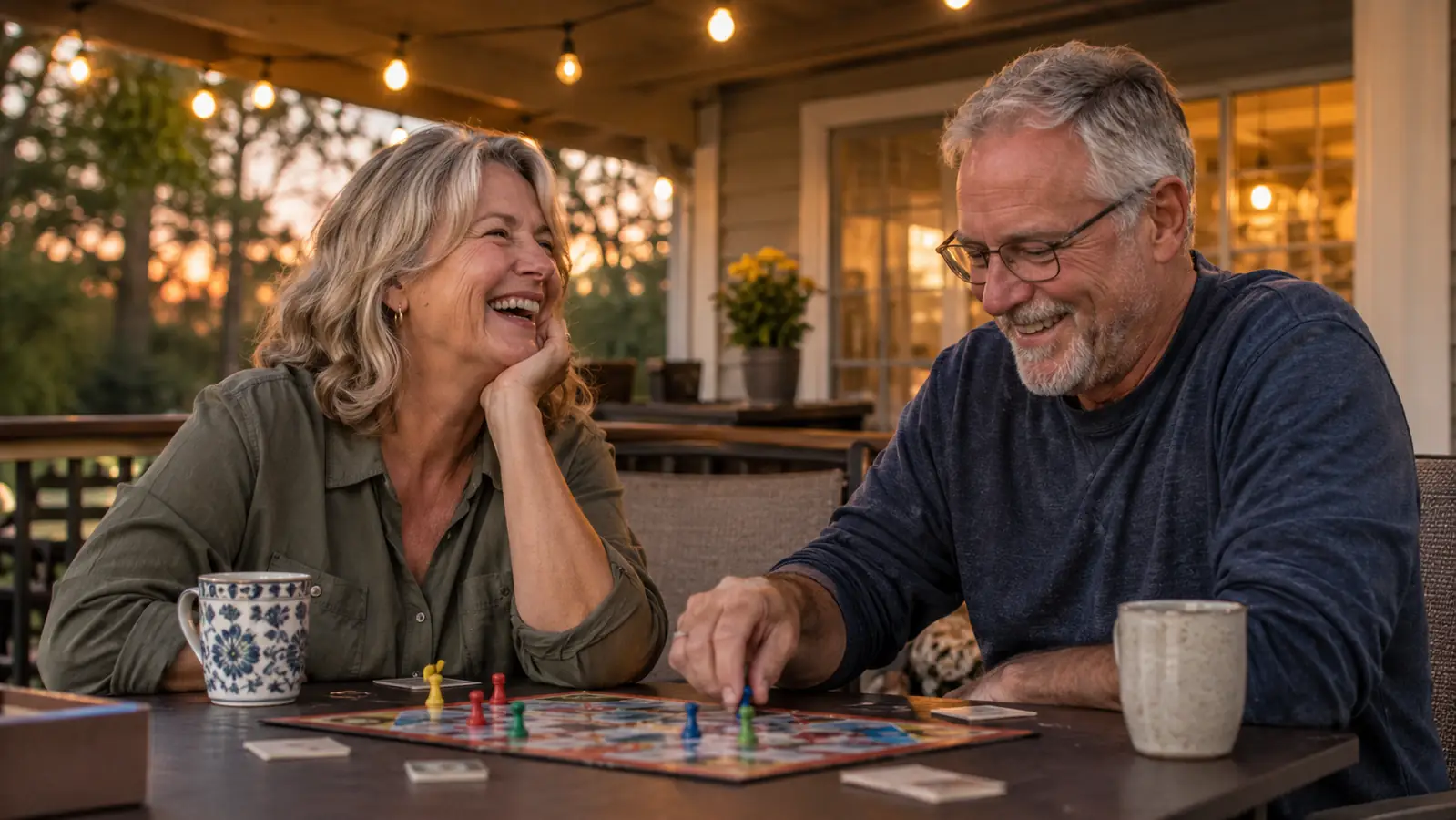
It helps to say where this sits among the other things on our sideboard, because not every game in that basket does the same job. Sunday after supper is a conversation deck, one or two cards, about twenty minutes. Tuesday is Jaipur, which is the competitive one, and Hal wins a little more than half the time. Thursday, if we are in the mood, is a light card game where we write answers on little boards and flip them over together. Every other Saturday we scratch off a date card. Friday is this.
Sky Team is the one that asks the most of us. The conversation deck asks us to be honest. This asks us to be clear, which is not the same thing and is somehow harder. I can answer an honest question about my childhood without much trouble, and then fall apart trying to explain which of two spaces I can cover with one die. There is something funny in that, and also something worth knowing. I played Lost Cities twice at my sister's house and enjoyed it well enough, but it is another head to head game and we already have one of those.
I have also bought worse things. We tried planning our own date nights back in the spring and ran out of ideas by the third week, which is why the scratch off cards from our daughter were such a good gift. If you are shopping for a couple, a two-player game is a safer present than a book about relationships, and this one is small enough to wrap without a box the size of a briefcase. Just know that you are handing them a small amount of homework along with the fun.
Who This Is For
This is for a couple who already like sitting at a table together and want a game where the two of you are on the same side of it. If you have a competitive game you both enjoy, Jaipur in our case, this makes a good second one, because it exercises a completely different muscle. It is also a fair choice for a newer couple, since nothing in the box requires you to know each other well. You will know each other better by the end of the evening, but the game does not demand that up front.
It is rated for ages twelve and up and for exactly two players, which suits a house like ours where the children are grown and gone. There is no reading aloud to a group, no waiting your turn while four other people argue, and no need to clear the whole table. If your evenings are short and your patience is shorter, that combination is worth more than any award sticker on the box.
If what you actually want is a conversation rather than a puzzle, buy a conversation deck and not this. I have looked at Let's Get Deep online and read the listing more than once, but I have never owned it or played it, so I am not going to pretend I can compare the two. What I can tell you is that Sky Team will get you talking, and it will not get you talking about anything that matters. It gets you talking about the approach.
Who Should Skip It
Skip it if one of you does not take direction well. This is the honest warning I would give any couple, and it is the one I would have wanted. Half of Sky Team is being told what your partner needs and then doing it, and if that arrangement makes somebody bristle at work, it will make them bristle at the kitchen table too. It is not a marriage problem. It is a personality fit, and you can usually tell within two runs.
Skip it if you need something you can play with four people, or if losing repeatedly ruins an evening for either of you. Skip it if you were hoping for a talking game. We keep a card deck for that and a jar of scratch off date cards for the other thing, and this box is neither. What Sky Team is, and what it does well, is give two people a small shared problem with a clear ending and a reason to say what they mean. That is worth a Friday night. It is not worth pretending it is easy.
Eight airports in, and we still say the plain thing first
Two players, roughly fifteen minutes a run, and a plane that does not care how long you have been married. Check today's price and whether the base game is in stock.
Amazon Check Today's Price on Amazon →