
I bought the BestSelf Co. Deeper Talk deck in January 2026 because our house had gotten too quiet. Hal and I have been married 31 years. Our daughter moved out in September 2025, and by Christmas I noticed we were eating supper in front of the television without saying much beyond who had the remote. I wanted a reason to sit at the round oak table again. I did not want a feelings exercise. Hal dislikes anything that smells like a feelings exercise even more than I do.
Ten months later, we have used roughly half the deck. Some Sundays it earns its place in the wicker basket on the sideboard. Some Sundays we skip it and watch a ballgame. That is the honest shape of this review. The BestSelf Co. Deeper Talk deck did not fix our marriage. It did give us a regular reason to sit down and find out what we had been not saying. It also gave us a few cards that fell flat enough to make us laugh and move on. That mix is what I want to tell you about.
The Quick Verdict
A real conversation starter for couples who will actually sit down, but the heavy cards need a skip pile and the first month can be stiff.
Amazon Check Today's Price →The deck we kept using after the new wore off
The BestSelf Co. Deeper Talk deck has 170 cards in six categories, and it works best when you draw one or two and let the night go where it goes. You can skip any card that does not fit the mood.
Amazon See the Deeper Talk Deck on Amazon →How I've Used It
We play on Sunday after supper, usually around 7:30, after the dishes are done. I take the deck out of the basket, we take turns drawing, and we answer one or two cards. That is about 20 minutes. We do not march through the six categories in order. We fan the cards and pick what looks bearable. Some weeks we stop after one. Some weeks one card turns into a longer talk and we never draw a second. There is no score and no winner. That took me a while to get used to.
Hal refused the first two Sundays. He sat at the table with his coffee and said he was fine. The third Sunday he sat through it. By about the sixth week he was answering without being asked twice. That is not a small thing in this house. He is 60, he works maintenance at a hospital, and he would rather talk about a clogged drain than about what he hopes for. The deck gave him a way in that did not feel like a spotlight. I noticed the difference before he did.
The box says 17 and up and 2 to 10 players. We use it as two. It weighs 7.36 ounces and it stays in the wicker basket next to the table. It is portable, but we have never taken it anywhere. It is a kitchen table deck for us. The categories are Courage, Beliefs, Life Lessons, Self-Awareness, Dreams, and Exposed. We have used roughly half the cards. I keep the heavy ones in a separate stack because some nights we are not up for them.
There is no timer and no rule about how long you have to sit. That is a plus for us. If a card lands and we are done, we are done. The deck does not make you finish a session. It just gives you a place to start.
What Nobody Tells You About the First Month
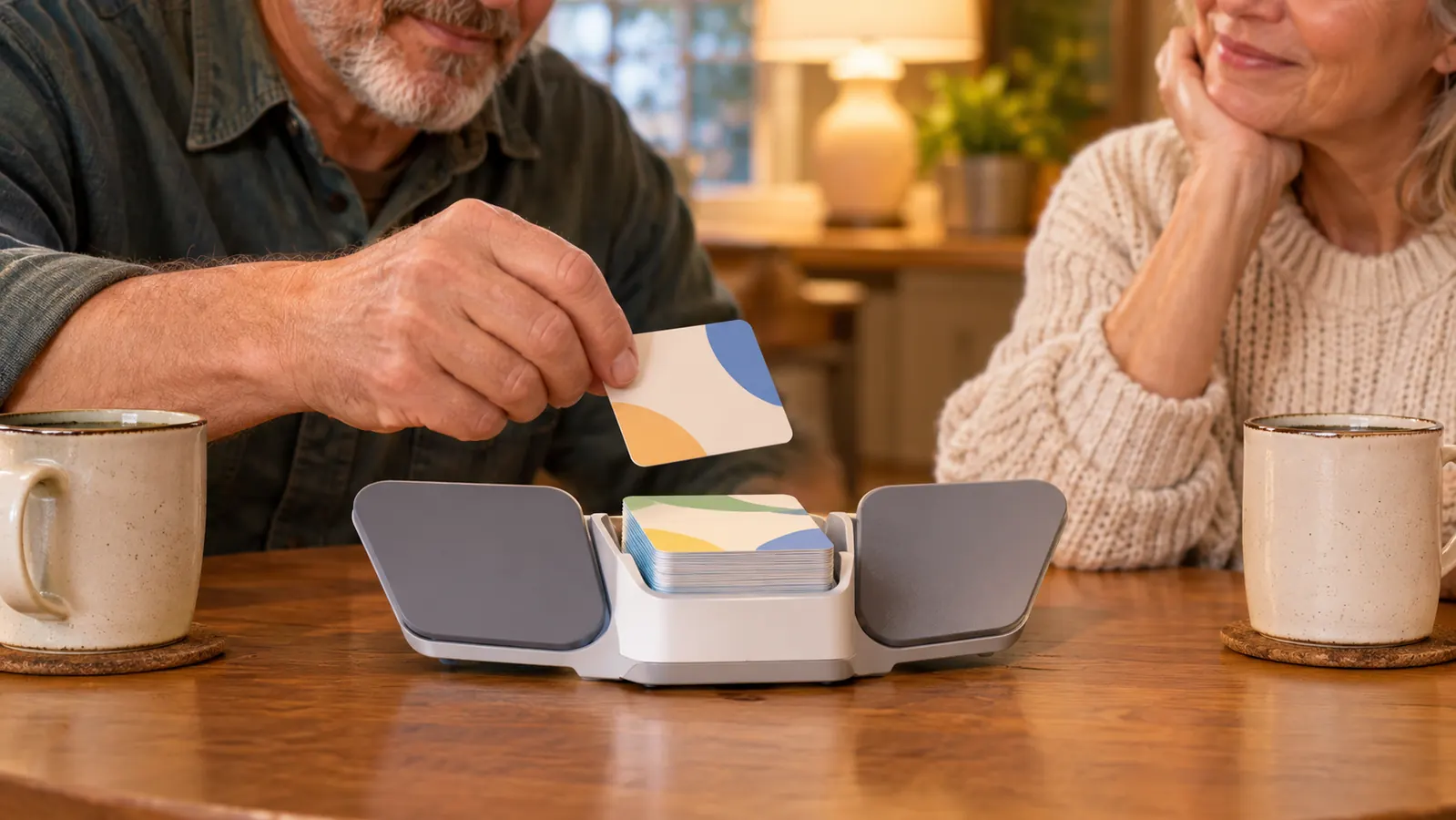
The first month is stiff. Nobody puts that on the box. You are two people who know each other's coffee order and how the other one loads a dishwasher, and suddenly you are asking a card a question that sounds like it came from a workshop. Hal's first answers were one word. Mine were too long. We were both trying to be good at it, which is the fastest way to make a conversation die. I almost put the deck in the donate pile after the second Sunday.
The fix was not a better card. The fix was lowering the stakes. We started drawing one card and giving ourselves permission to say, Pass. We also stopped trying to have a deep talk every Sunday. If the card landed heavy and one of us was tired, we said so and moved on. The deck does not police you. It is a box of prompts. You are allowed to use it like a tool and not like a test. That sounds obvious. It took us a month to act like it.
I also made a mistake in the beginning. I treated the card as a prompt for a serious talk. I would draw one and lean in like we were on a talk show. Hal would shut down. When I stopped leaning in, he started talking. The deck works better when you act like you are passing a biscuit, not opening a hearing. That is the part nobody tells you. The tone you bring to the table matters more than the card you draw.
By week six, the rhythm felt normal. That is the part I would tell a friend. The deck did not make us deep talkers overnight. It made the table a place where a real question could get asked without a fight about who started it.
The Categories Do Not Hit the Same
Courage and Beliefs got us talking fastest. Those cards ask you to name something you would do if you were braver or what you believe about a part of life you do not talk about at supper. Hal can answer those because they sound like opinions. He has opinions. He does not always have words for the softer stuff. I learned to start there when I could tell he was not in the mood for a longer reach.
Life Lessons and Self-Awareness are slower. They ask you to look back and say what you learned or what you wish you had known. Those are good cards for a Sunday when we are both rested. On a Tuesday after a long shift, they are too much. We have learned to save them. The deck does not tell you how to order the categories. We did not start with Courage because it sounded brave. We started with whatever card was on top. That was better.
Dreams is the category I expected to be silly and it was not. It asks about what you still want to do, not just what you want to buy. That one got Hal talking about a trip he has wanted to take for years. We have not taken it. But I know about it now. That is worth something. Exposed is the category we handle most carefully. Some of those cards ask for more than we want to give on a given night. We skip them. I do not think that makes us bad at the deck. I think it makes us honest.
The categories are there for you to choose from, not a curriculum. You do not have to finish one before you move to another. We have jumped around from the start. That keeps it from feeling like a workbook. The deck is a set of doors. You open the one that fits the night.
Where It Actually Helped
The deck helped most in the small gaps. I learned Hal worries about retirement in a way he had not said out loud. He is not a worrier by nature, so I had missed it. He learned that I miss the noise of the kids more than I let on. Our son moved out years ago and our daughter moved out in September 2025. I had been treating the quiet like a problem to solve by keeping the television on. That was not a conversation we had until a card put it on the table.
It also changed the way we eat supper. That sounds too big for a card deck, so let me shrink it. We still watch television some nights. But Sunday after supper is now a table night. The dishes get done, the television stays off, and we sit down. Sometimes we play Jaipur on Tuesday and Sky Team on Friday. Sunday is the talking night. That rhythm came from the deck. It did not come from a resolution.
The deck also gave us something to do with a Sunday that used to be a little sad. The house is quieter now. I do not say that to get sympathy. It is just true. A card on the table gives the quiet a shape. It is easier to sit with a quiet house when you have a small job to do together. The job is answer one question. That is small enough to start.
I am not going to tell you it saved anything. We were not in a crisis. We were quiet. There is a difference. The deck gave us a way to be quiet together less often. If your house is in real trouble, this is not the fix. If your house is just quiet, it is a good place to start.
The deck did not fix our marriage. It gave us a reason to sit at the table long enough to find out what we had been not saying.

What Fell Flat
Some cards are too abstract. You read one and think, what does that even mean? Those are the ones that get a shrug and a pass. A few prompts feel like they were written for a group, not a couple. The box says 2 to 10 players, so that makes sense. With two people, some cards have less room to breathe. The deck is not tailored to a married couple at a kitchen table. It is a broad deck, and broad means a few misses.
After 10 months, a handful of cards feel familiar. We have used about half the deck, so we still have a lot left. But the ones we have drawn more than once have lost their edge. That is not a flaw exactly. It is what happens when you use a tool. The deck is not a new movie. It is a set of questions, and some of them will wear a path. We have started to shuffle more carefully to avoid the ones we know.
Hal can still give a one-word answer when he is not in the mood. The deck cannot fix that. It can only give him a better question than asking how work went. It also cannot make a tired person energetic. If we sit down too late or after a bad day, the cards feel like homework. We have learned to skip it on those nights. A deck that sits in a basket for a week is not a failure. It is just a deck.
The cards are not a personality test. They will not tell you who your husband is. They will only give him a chance to say something he might not have said. If he does not take it, the card is not broken, and neither is he. That is a hard lesson for a wife who likes to fix things. I am still learning it.
How It Compares to the Other Things on Our Table
The first conversation deck we owned was a cheap small-talk deck our daughter gave us in late 2025. We used it up in a few weeks because the questions stayed on the surface. It was fine for a car ride. It did not get us to the table on a Sunday. The BestSelf Co. Deeper Talk deck is a different animal. It asks more of you, and that is both the reason it works and the reason some cards get skipped. If you want easy, this is not the easy one.
Jaipur is Hal's favourite. It is a two-player trading game about rival merchants, about 30 minutes a game, and it took us two games to stop checking the rules. Hal wins a little more than half the time. It is the competitive game, and it is the one that got him to look forward to a night at the table. Sky Team is the cooperative one. We are pilot and co-pilot landing a plane, and we crashed our first three attempts before landing on the fourth. We have flown about 8 of the 20 airports. It is the game where we are on the same side.
The Couples Game is the light one. We bought it in August 2026, and it is a tin with 150 cards and two dry-erase boards. We write answers and flip them together. Hal laughed out loud the first night. It is for tired nights when Deeper Talk would be too much. The scratch-off date cards are for getting out of the routine. Our daughter gave us those for our 31st anniversary in June 2026. We have scratched 10 of the 35. Two were duds and we did them anyway.
I have looked at Let's Get Deep online, but I have never owned it or played it, so I cannot compare it. I played Lost Cities twice at my sister's house and never bought it. Planning our own date nights sounded good in spring 2026 and ran out of ideas by the third week. The deck is not the only thing that works. It is the thing that fit our Sunday. That is a small claim and an honest one.
If you are choosing between this and a date night plan, I would say they do different jobs. The date cards get you out of the house. The deck gets you to stay in the house and talk. We need both. One is not a substitute for the other. The deck is the easier habit, and it is the one we use more often.
What I Liked
- 170 cards in six categories, so the deck lasts a long time
- Turns a vague Sunday into a 20 minute table habit
- Allows skipping any card without breaking the night
- Works for two players even though the box says 2 to 10
- Portable box, 7.36 ounces, easy to keep near the table
Where It Falls Short
- First month can feel stiff and forced
- Exposed category is too heavy for some nights
- A few prompts are abstract enough to get a shrug
- Hal can still give a one-word answer if he is not in the mood
- Not a game, no winner, no rules to hide behind
Who This Is For
For couples who will actually sit down. If you can get both people to the table for 20 minutes and agree that passing on a card is allowed, the BestSelf Co. Deeper Talk deck can give you a regular rhythm. It is good for long-married couples who have run out of things to say besides the kids, the bills and the schedule. It is also good for newer couples who want a low-pressure date night at home without a screen. The 17 and up age note fits. It is a conversation deck, not a party game. It works best with two people who are willing to be a little honest and a little patient with each other.
Who Should Skip It
Skip it if you want a game with rules and a winner. This is not that. Skip it if either person treats a feelings exercise like a trip to the dentist three Sundays in a row. The deck cannot carry the whole thing. Skip it if you are looking for a quick fix for a marriage in real trouble. I am not a counselor and I am not giving therapy advice. We were quiet, not in crisis. A deck is a deck. It is also not for a couple who wants every card to be light. Some of these cards ask real questions, and if that sounds like too much, The Couples Game is a better fit for a tired night.
If Sunday at your house sounds like ours did, start with one card
You do not need a whole program. Put the BestSelf Co. Deeper Talk deck in a basket, clear the dishes, and draw one card. Skip the ones that do not fit. The point is the table, not the score.
Amazon See the Deeper Talk Deck on Amazon →