
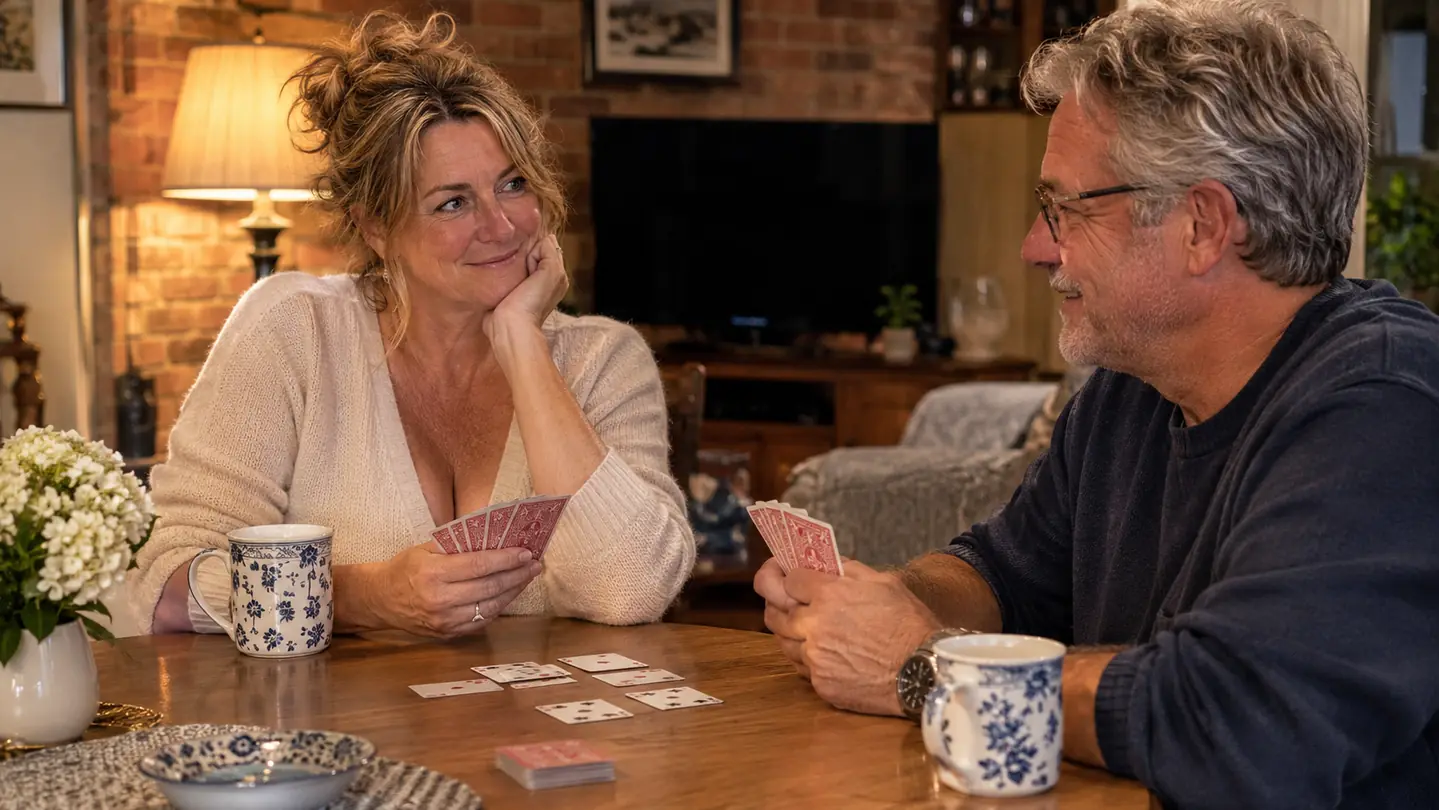
Hal and I ate supper in front of the television for the better part of a year before I noticed we had stopped talking. Our daughter moved out in September 2025. Our son had been gone for years by then. The house got quiet in a way I was not expecting, and somewhere between the six o'clock news and the dishes, we settled into a routine where the only things we said to each other were about the bills, the schedule, or which of the kids had called last.
It was not a crisis. Nobody was angry. We were just quiet, and quiet is easy not to fix. I bought our first deck of conversation cards in January 2026 because I wanted a reason to sit at the round oak table instead of the couch. That deck helped. But the thing that changed our week was smaller and sillier than I expected: a two-player card game about selling goods in India. Jaipur is made by Asmodee. It is for exactly two players, ages 10 and up, and a game runs about 30 minutes.
Two players, thirty minutes, and a reason to stay at the table
Jaipur is the Asmodee two-player game that got Hal asking what night we were playing. Ages 10 and up, about 30 minutes a game, and it fits on a kitchen table beside two coffee cups.
Amazon Check today's price on Amazon →Step 1: Pick a night that already has a rhythm
Tuesday worked for us because Tuesday has nothing else in it. Hal works days and is home by 5:30. Supper is about 6:30, the dishes are done a little after seven, and nobody is going anywhere on a Tuesday. Sunday already had a shape from the conversation deck and Friday is kept for something else, so Tuesday was the open slot. The mistake I nearly made was deciding we needed a whole evening for it. We do not. Jaipur plays in about 30 minutes, and we usually play a match, which is a couple of those. From dishes to bed it is maybe an hour and fifteen minutes, and we are not staying up late to do it.
Pick the night by looking at what already happens, not by picking the night you wish were free. If Wednesday is the night Hal works late, Wednesday is a lie you are telling yourself. If Saturday is full of yard work and errands, Saturday is a lie too. The night that works is the boring night, the one you would otherwise spend in front of the television not saying anything.
Then put it on the calendar. I know that sounds like homework, and I am not a homework person. Do it anyway. Write it on the paper calendar by the phone the way my mother did, or put it in the phone, and say it out loud once so the other one hears it. Hal and I said it out loud in March and we have not had to say it again since.
Step 2: Learn the game before you play it in front of anybody
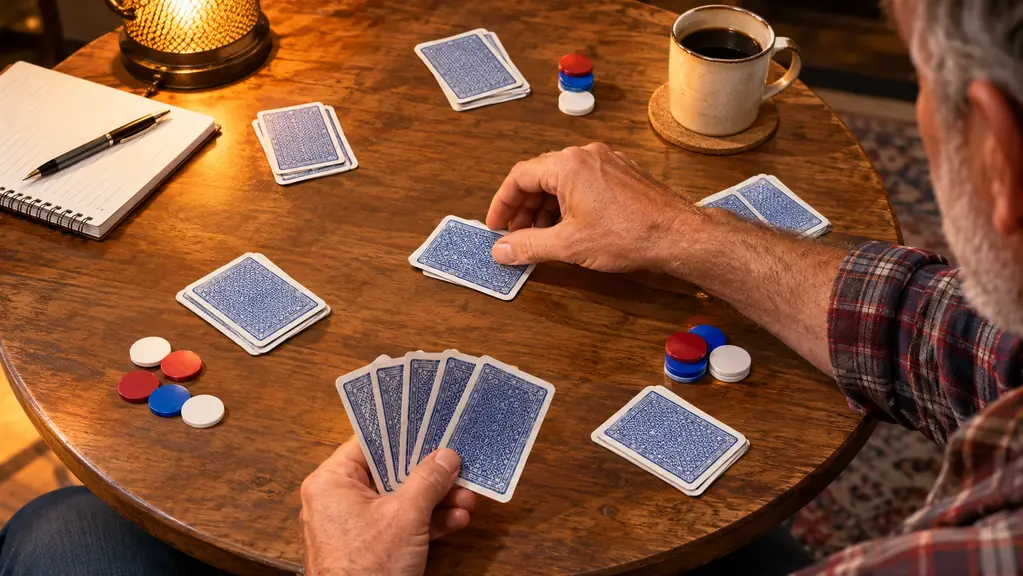
I opened the box on a Wednesday afternoon while Hal was at work, and that was on purpose. Jaipur is not complicated, but it does have a hand of cards, a market of cards laid out in the middle of the table, and goods tokens you collect when you sell. The first game is spent figuring out what you are even allowed to do. The second one is where it starts to click.
Two games is what it took us to stop checking the rules. That is not a knock on the game, which comes with rules of play in the box. It is just how long it takes two people to stop looking things up and start playing. By the end of that Wednesday I had a fair idea of what I was doing, which meant that when Hal sat down on Tuesday I was not reading instructions out loud to a man who had just eaten supper and wanted to be left alone. His first game was my third. He still beat me.
One more thing, and I mean this: do not teach it during supper. Hal is not at his best with a rulebook and a plate in front of him, and neither am I. Wait until the dishes are up.
Step 3: Clear the table so the game is the only thing on it
The round oak table is where everything in our house lands. Mail, Hal's reading glasses, the basket of things that do not have a home, a stack of napkins. If we sit down with all of that still on it, the game becomes one more object on the table instead of the thing we are doing. So the whole ritual is this: clear the table, set the box down, and leave the phones in the other room. Not face down on the table. In the other room. The first month I left mine in the kitchen, it buzzed twice, and I looked twice. Now it goes on the charger in the bedroom and I have not missed anything yet.
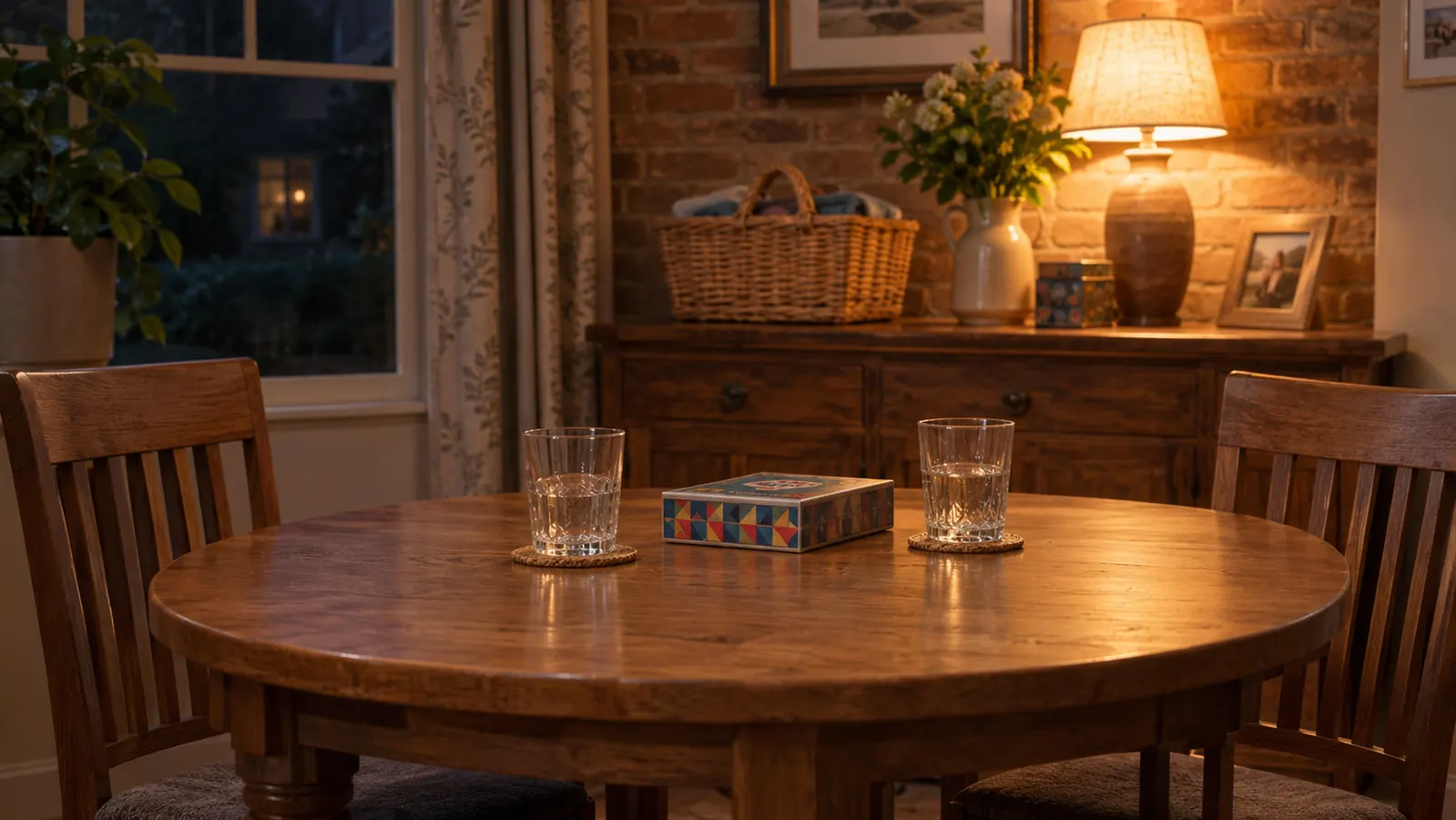
Set the table like you plan to be there a while. Two glasses of something, a bowl of whatever is in the pantry, and the game. That is the entire setup, it takes four minutes, and it makes the evening feel less like an appointment and more like something you would choose.
We have played Jaipur on Tuesday nights since March 2026, and in those eight months I have learned more about my husband's Tuesday self than I learned in the five years before it.
Step 4: Play short the first month, even when it is going well
The temptation, once you both know the rules, is to play until somebody has had enough. Do not. The first month we played one match and stopped. A match is a set of rounds and the whole thing, start to finish, is about 30 minutes of actual playing, so with the table and the dishes you are looking at an hour and fifteen. When it went well I wanted to keep going, and I am glad we did not.
The Asmodee box comes with three seals, and a match goes to whoever takes two of them. Hal takes his seal, sets it in front of his coffee cup, and leaves it there for the rest of the evening. It is a small piece of cardboard doing a great deal of work.
Stopping while it is still fun is the whole trick. Hal is competitive in a way that surprises people who assume maintenance supervisors are mild. If we play until he loses, he goes to bed sore. If we stop at a good point, he goes to bed wanting to play again next week, and that is the feeling you are trying to build in the first month. He wins slightly more than half the time, by the way. I have kept a tally on the back of a grocery list since April. He does not know about the tally.
Step 5: Keep a running score so there is something to come back to
Jaipur does not come with a season standings sheet, so we made one. It is a piece of notebook paper on the sideboard, and every Tuesday gets a line: the date, who won, and one word about how it went. Close. Ugly. Fast.
That sheet is doing more work than it looks like. It means Tuesday is not an isolated hour that either goes well or does not. It is a series, and there is something waiting to be continued. Hal is ahead. I am aware of how that sounds and I am not going to pretend I do not care.
The other thing that keeps a game night alive is where the game lives. Ours sits in a wicker basket on the sideboard next to the table, with everything else. If the game is in a closet, game night is an event you have to plan. If it is on the sideboard, it is just Tuesday. We have missed weeks. That is normal. A missed Tuesday is not a reason to quit. It is a missed Tuesday.
What Else Helps
Jaipur is the one that started this for us, but it is not the only thing in the basket, and it helps to know what each one is for.
When we want to laugh instead of compete, we use The Couples Game. It is the newest thing in the house, three months old, and it is the light one, for tired nights when a real conversation would be too much. Hal laughed out loud the first night we played it. His handwriting on the dry-erase board is a running joke in this house and I intend to keep it that way.
When we want to be on the same side of something, we play Sky Team. Two players landing a plane, eight dice, a control panel, twenty airports. We crashed the first three attempts and landed on the fourth, all in one evening. It is the one game where we are not against each other, and on a night when competing would put Hal in a mood, that matters.
When we actually want to talk, we use the conversation deck we bought in January. One or two cards, about twenty minutes, and we skip anything either of us does not want to answer. The scratch-off date cards our daughter gave us for our anniversary get us out of the house now and then. You scratch a card, you do the date you scratched. That is the rule. Two of the ten we have done were duds, and we did them anyway and laughed about them.
What I would skip is a cheap question deck from a discount bin. Our daughter gave us one in late 2025 and we used it up in a few weeks because the questions never got past the surface. A game that gives you something to do with your hands beats a card that asks you to be honest on command. That is the difference between Jaipur and a deck of questions, and it is why the Asmodee box is the one I would buy first.
I never thought of myself as a game night person. I thought that was for people with small children and a coffee table full of snacks. It turns out it is for anybody who wants an hour on a Tuesday where the television is off and there is a reason to stay at the table instead of drifting off to the couch.
Start with one Tuesday
You do not need a shelf of games. You need one that two people can play in half an hour at the kitchen table, with the phones in the other room.
Amazon See Jaipur on Amazon →