
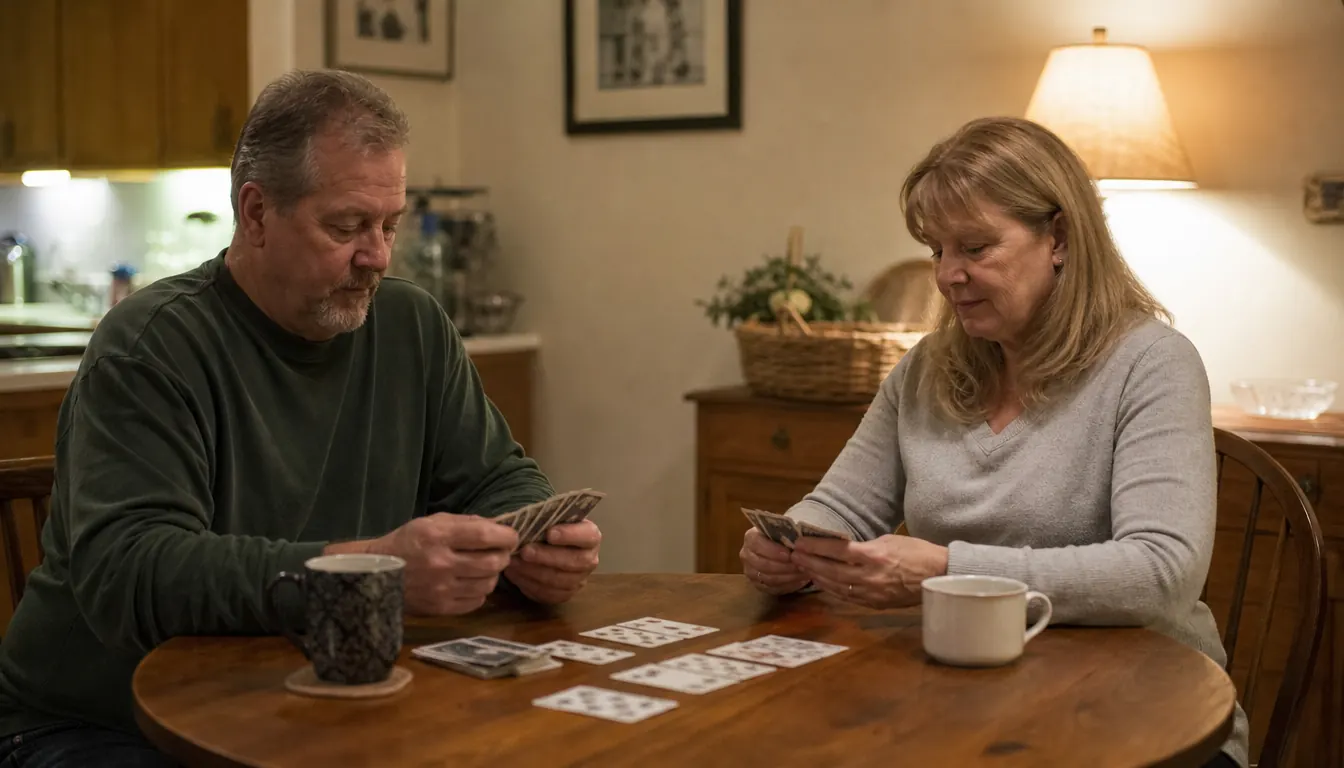
The Asmodee Jaipur box has been sitting in the wicker basket on our sideboard since March, and it has become the one thing Hal asks for without being asked. We bought it eight months ago, after I got tired of eating supper in front of the television without a word between us. I am 57. Hal is 60. We have been married 31 years, and we are not a couple who needed a rescue. We were just quiet. Jaipur gave us a Tuesday night job, and I mean that in the best way.
Here is what nobody tells you before you buy it. Jaipur is not a conversation deck. It will not ask you about your childhood or your fears. It is a two-player trading game about beating the other merchant to the better deal, and the talking happens around the edges. That turned out to be exactly why Hal liked it. He does not want a card to ask him how he feels. He wants a card to play.
The Quick Verdict
A sharp, quick two-player game that got my quiet husband to the table and kept him there, with a luck factor that can sour a close night.
Amazon Check Today's Price →If your table has gone quiet, start with the game Hal asks for
Jaipur is built for two players, plays in about 30 minutes, and fits in a basket when you are done. It is the lowest-friction way we have found to sit down together on a weeknight.
Amazon Check Today's Price on Amazon →How I've Used It
We play on Tuesdays here in Tyler, usually after the dishes are done and before the ten o'clock news. Supper is around 6:30. Hal is home by 5:30. By 7:30 we have the table cleared, the basket open, and two cups of coffee going. The game takes about 30 minutes according to the box, and that is close to what we see. Some rounds run a little longer when we both get stubborn about a trade. Some run shorter when one of us gets a run of good draws. We almost never play more than two rounds in a night, because Tuesday is a work night for Hal.
The first two games were slow. We kept the rules sheet on the table and checked it after every turn. The Asmodee rules are not long, but the game has more small decisions than it looks like from the outside. Which goods do you take? Which do you sell? When do you hold back? By the third game we stopped checking, and by the fifth we were talking about the game instead of the rules. That is the point where it became ours.
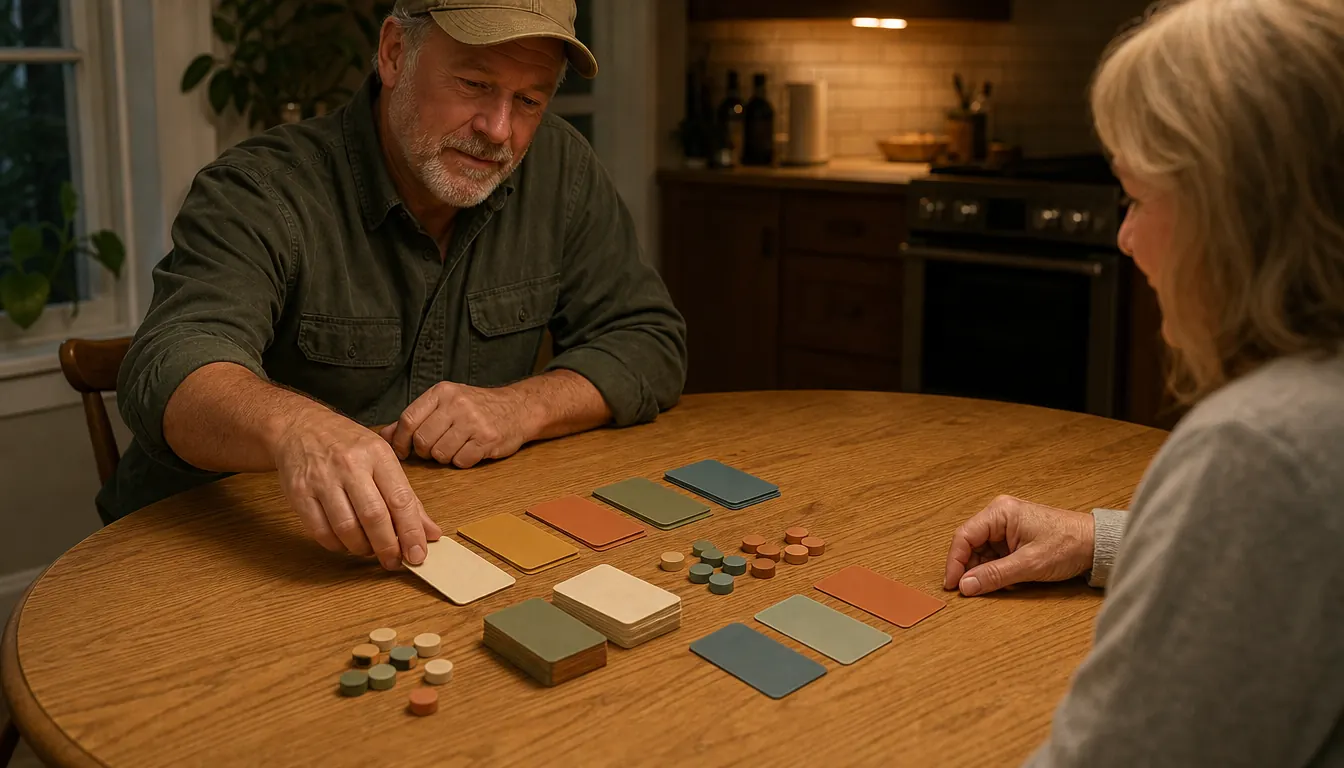
I keep the Asmodee box in the same wicker basket as our other table games. It is small and light, 231 grams according to the listing, so it does not take up the space a board game would. There is no board. The whole thing is cards and tokens: 55 goods cards, 38 goods tokens, 18 bonus tokens, one camel token and three seal tokens. That sounds like a lot of pieces, but setup takes about a minute once you know what you are doing. Hal can set it up while I pour the coffee.
What the Listing Does Not Tell You
The listing tells you it is for two players, ages 10 and up, and that a game takes about 30 minutes. All true. What it does not tell you is that Jaipur is a competitive game first and a couple's activity second. That sounds obvious, but I have bought games that were sold as date night and turned out to be cooperative chores. This is not that. You are rival merchants. One of you wins. The other one does not. If you have a husband who sulks when he loses, you will see the sulk.
The second thing nobody tells you is that luck is real. You can play well and still lose a round because the cards did not come your way. The game is built on card drafting, hand management and set collection, and those choices matter. But the draw matters too. Hal wins a little more than half the time, and he will tell you that is skill. I have watched him win on a draw that handed him three good cards in a row. I have also watched him lose the same way. A close game is exciting. A lopsided game is over before it starts.
The third thing is that the game is quieter than you might expect. This is not a party game. There is no shouting, no charades, no big reveal. Two people sit across from each other, look at their cards, and make small decisions. The talk is low and practical. I take the spices. You take the cloth. I am not selling yet. That kind of talk. For us, that is a feature. If you need a game that fills a room with noise, this will not do it.
The fourth thing is that the box is small. I mean that literally. It is 231 grams. It fits in a basket. It does not look like a big deal on the shelf. If you are buying a gift and you want something that looks impressive wrapped up, Jaipur is not that. If you are buying something to actually use on a Tuesday, the size is a gift. It does not need its own shelf. It does not need a table leaf. It does not need a whole evening.
What a Tuesday Actually Looks Like
Hal gets home at 5:30. We eat at 6:30. He does not like to be rushed through supper, and I do not like to eat in front of the television anymore. By 7:30 the dishes are done and the table is clear. I open the basket and set the box down. Hal takes his chair. He does not say much. He never does. But he reaches for the cards, and that is the whole point. The game gives him a way to be at the table without having to make conversation first.
The first round is usually the warm-up. We are both a little tired. We make safe choices. The second round is the real one. That is when Hal starts planning two turns ahead and I start watching what he is collecting. The game is about reading the other person as much as it is about the cards. If he is buying silver, I know he is going for a set. If I take the cloth before he can, he changes his plan. That back and forth is the part I did not expect. It is not deep, but it is real.
We finish in about 30 minutes. Sometimes we play a third round if the second one was close and neither of us wants to stop. We almost never go past 8:30. That matters to me. I did not want a hobby that ate our evenings. I wanted a small ritual that fit inside one. Jaipur fits. The dishes are done, the coffee is cold, and we go to bed having done something together that was not television.
The Parts That Wear Thin
After eight months, I can tell you the game does not change much. That is not a flaw exactly. It is a small game with a fixed set of goods and a fixed set of decisions. If you play it once a week, it holds up. If you play it every night, you will get tired of it. We play on Tuesdays and sometimes on a rainy Saturday. That is the right dose for us. If you are looking for a game with a campaign, new scenarios, or a story that unfolds over months, this is not that.
The competition is also the thing that can go wrong. Hal is competitive at board games. Most of the time that is fun. On a bad night, when he has had a long day at the hospital, a loss can sit on him. He does not yell. He just gets quiet in a different way. I have learned to let it go. I do not rub it in. We put the game away and watch something. That is not a flaw in Jaipur. It is a fact about playing a competitive game with a competitive man. If your partner is the same, know what you are getting.
The two-player limit is another real tradeoff. This is not a game you can pull out when your daughter visits. It is not a game for four. It is not a game for a group. It is for two people at a table, and that is it. For us, that is fine. Our children are grown and out of the house. For a family with kids at home, it means this is a parent-and-child game or a couple game, not a family game. The box says ages 10 and up, so an older child can play. A younger one cannot join in the same way.
Where It Surprised Me
The surprise was not that Hal liked it. The surprise was that he talked about it the next morning. He is not a man who narrates his feelings. But he will say, over breakfast, that he should not have sold the silver so early. Or that he saw what I was doing with the spices and could not stop me. That is a small thing. It is also more conversation than we were having in September 2025, when the house got quiet and the television did most of the talking.
The other surprise was that the game gave us a shared problem. We were not sitting across from each other trying to come up with something to say. We were looking at the same cards, the same tokens, the same small decisions. That took the pressure off. I have friends who say they do not know what to talk about after thirty years. I understand that. Jaipur did not give us a list of topics. It gave us something to do while the talking happened on its own.
I want to be careful here. Jaipur is a game. It did not fix anything, because nothing was broken. We were two people who had gotten out of the habit of sitting together. A game is a small tool for a small problem. If your marriage is in real trouble, a card game is not the answer. That is not what this is. This is for the couple who eats supper in silence and would rather not.
What I Liked
- Sets up in about a minute once you know the rules
- Plays in roughly 30 minutes, which fits a weeknight
- Small and light, so it lives in a basket instead of on a shelf
- Gives a quiet partner a job at the table
- Enough competition to keep a competitive husband interested
Where It Falls Short
- Luck of the draw can decide a close round
- Only two players, so it excludes the rest of the family
- Can feel repetitive if you play it several nights a week
- A competitive partner may sulk after a bad loss
- Not a conversation game, despite how it gets sold
Hal wins a little more than half the time, and he still asks for Tuesday. That is the review.
Who This Is For
This is for couples who like a little competition and have about 30 minutes on a weeknight. It is for the partner who does not want to be asked how they feel but will happily take a card and try to beat you. It is for people who have a kitchen table and a basket and no interest in building a whole evening around a game. It is also for a parent and an older child who want something to do together that is not a screen.
It is for couples who are not in crisis. I say that plainly because I have seen games sold like therapy. Jaipur is not therapy. It is a way to sit down. If you are looking for a game that starts conversations, this can do that around the edges. If you are looking for a game that forces deep talk, this is not it. That is a different box, and I have one of those too.
Who Should Skip It
Skip it if you need a cooperative game. Some couples do not do well with competition. If one of you sulks, or if the other one cannot resist a victory lap, a competitive two-player game is a bad fit. Sky Team is the one we play when we want to be on the same side. Jaipur is the one we play when we want to see who is better on a Tuesday. Know which couple you are.
Skip it if you want a group game. It is two players only. Skip it if you want a game with a long campaign or a lot of variety. Skip it if you want a conversation deck. And skip it if you are looking for a gift that looks big and impressive on Christmas morning. It is a small box. The value is in the playing, not the packaging.
What I Would Tell a Friend
If a friend asked me whether to buy it, I would say yes, with one condition. Buy it if you have a partner who will actually sit down for 30 minutes. Not a partner who says they will and then picks up their phone. Jaipur needs two people at the table. If you have that, it is one of the easiest yeses in our basket. It is small, it is quick, and it has enough bite to keep a competitive man interested.
I would also tell her to give it two games before she decides. The first game is rules. The second game is the real game. By the third, you will know whether it is yours. If it is not, put it in the basket and try something else. That is what we did with the others. The point is not the game. The point is the Tuesday.
The game that got my quiet husband to the table
Two players. About 30 minutes. One small box that fits in a basket. If you want a weeknight reason to sit down together, this is the one we reach for.
Amazon Check Today's Price on Amazon →